
Emergency Guides
Ceiling Leaking During a Storm? What to Do in the Next 30 Minutes
Dealing with this right now? We answer 24/7 and dispatch across Rancho Cucamonga in 60 minutes.
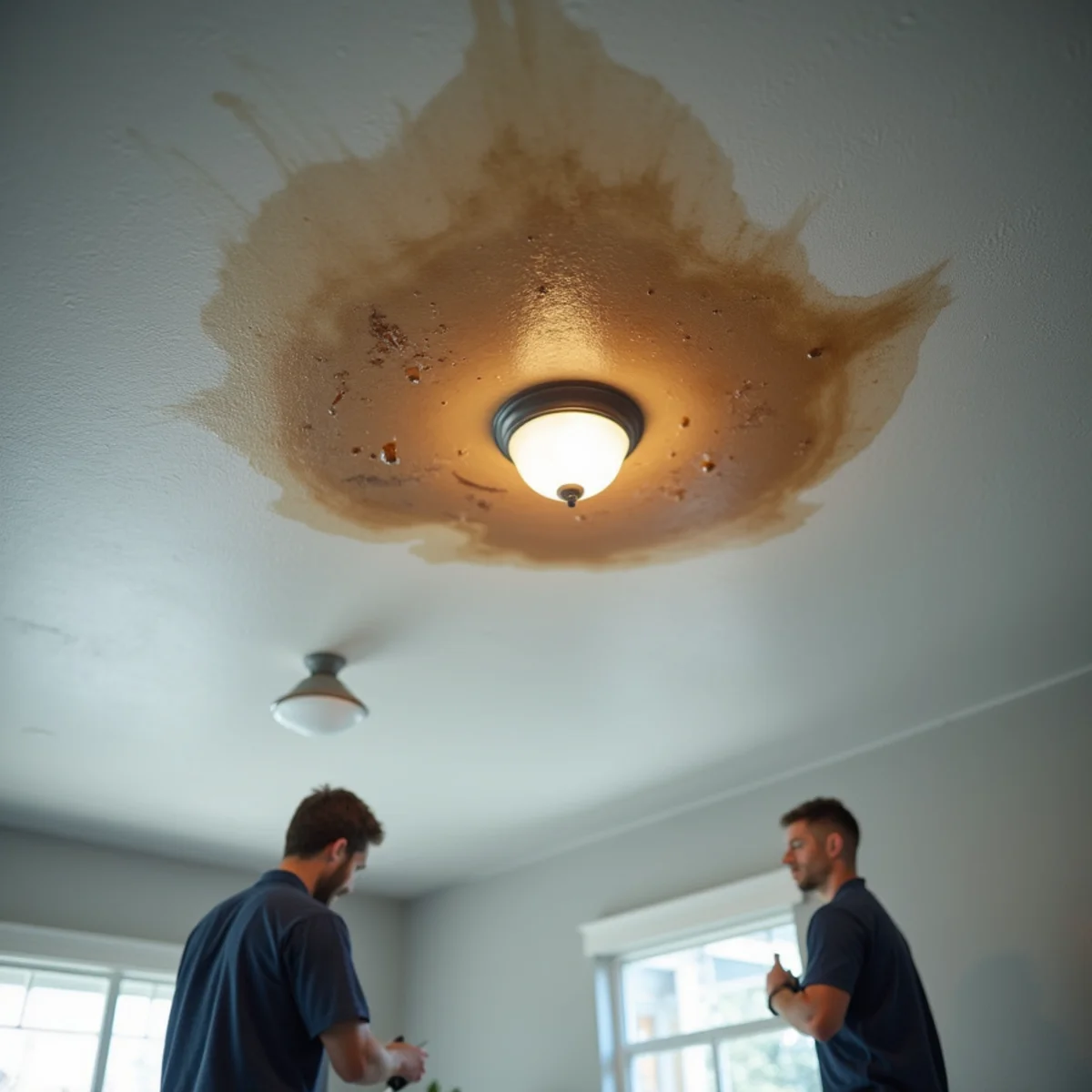
+1 (201) 277-9344Water coming through a ceiling during a storm is one of the few water emergencies that's also a physical safety problem. Wet drywall holds a surprising amount of weight, and it doesn't sag gradually and then stop — it fails all at once.
Here's the sequence.
First: clear the room
If the ceiling is sagging, bulging or bubbling, get everyone out from underneath it and keep them out. That includes pets. A saturated section of drywall coming down can genuinely injure someone.
Move what you can from the perimeter of the room without walking under the affected area.
Second: kill the circuit
If water is anywhere near a ceiling light, a fan or a smoke detector, turn off that circuit at your breaker panel.
Water entering a ceiling follows the path of least resistance, and fixture penetrations are exactly that. A light fixture dripping water is an energised fixture full of water.
Don't test it by turning the light on.
Third: catch and contain
Now, if the ceiling isn't bulging:
- Buckets, bins, a cooler — under the drip
- A towel in the bottom of each bucket kills the noise and stops splashing
- Plastic sheeting or a tarp over furniture and flooring you can't move
- Move rugs out entirely
If the drip is spread across a wide area rather than a single point, a tarp draped across the room and funnelled into a bin buys you time.
Fourth: the bulge decision
This is the hard one and it deserves a straight answer.
A bulge means water is pooling on top of the drywall. Left alone, it will eventually fail — and when it does, everything comes down at once along with whatever insulation is sitting on it.
If a restoration crew can be there shortly, wait. We relieve those in a controlled way.
If you're genuinely on your own with water pooling and no help for hours: a small relief hole at the lowest point of the bulge, with a bucket underneath, is better than an uncontrolled collapse. Do it from the side with a screwdriver on an extension, never standing underneath, and only after the circuit is off.
Start with one small hole. Water will come out fast.
What not to do
Don't punch a big hole. A small relief point drains it; a large one drops the panel.
Don't push the bulge back up. Nothing good happens.
Don't get on the roof during or after a storm. Post-storm roof falls are a real hazard, wet tile is slick, and walking on concrete tile cracks more of it. There is nothing you can accomplish up there in the rain that's worth it.
Understanding what's actually happening
Here's the thing most homeowners don't know: the leak is almost never directly above the stain.
Water entering through a roof runs downhill along the framing — rafters, truss chords, the top plate — until it hits an obstruction or a penetration and drops through. Ten to fifteen feet of horizontal travel is entirely ordinary.
Which is why opening the ceiling directly above the wet spot frequently finds nothing, and why professional ceiling water damage repair starts with thermal imaging from below and attic inspection from above to trace the water back to the actual entry point.
Why this is happening in December when the wind was in October
If you're in Rancho Cucamonga or the north end of the valley, there's a good chance this leak was created two months ago.
Santa Ana winds run October through March, funnelling through the Cajon Pass and across the north of the valley. They don't need to strip a roof to cause a leak — lifting is enough. A concrete tile lifts and reseats slightly proud. Ridge flashing bends. A vent boot cracks. Underlayment tears at a fastener.
None of that leaks in October, because it doesn't rain in October. Then the first atmospheric river arrives and finds an opening that's been sitting there for weeks.
That's why the north-facing foothill neighborhoods — Hunter's Ridge in north Fontana, Etiwanda, Deer Creek — see this pattern most.
What matters for your claim
Wind damage is a covered peril on standard California homeowners policies, and water entering through a wind-created opening is generally covered as a consequence of that wind damage.
That causal chain is the whole claim, which means documentation matters:
- Photograph the interior damage as it develops, with timestamps
- Note the storm date and, if you can, the earlier wind event
- Don't discard wet insulation or drywall before your adjuster sees it
- Keep every emergency service invoice — emergency mitigation is frequently reimbursable separately
What isn't covered is a roof that simply failed from age. Which is why the wind evidence, where it exists, is worth documenting properly rather than assuming.
When it turns out not to be the roof
A ceiling leak during a storm feels like an obvious diagnosis, but three other causes present identically and it is worth knowing them before a roofer is booked.
HVAC condensate. An air handler in the attic produces a surprising volume of water, and a blocked condensate line or a rusted-through drain pan drips onto the ceiling below. The tell is that it happens when the system is running rather than when it is raining — though in a wet, cool spell both are true at once.
Plumbing above. A supply line or a shower pan on an upper floor produces a ceiling stain that looks exactly like a roof leak. The distinguishing feature is timing: plumbing leaks do not care whether it is raining.
Wind-driven rain at a wall. Water entering at a window head, a slider or a poorly flashed wall penetration can travel along framing and appear at a ceiling several feet away, giving every impression of having come through the roof.
The attic tells you which one you have. Water tracking down a truss from a specific point above means roof; a wet drain pan or a soaked line means neither.
Then get it tarped
Before anything else can be dried, the intrusion has to stop. Emergency tarping — properly battened, not weighted with sandbags that shift in the next gust — holds through the rest of the storm season, which matters because after a regional wind event every roofer in the Inland Empire is booked for weeks.
Then the real work happens above your ceiling: removing saturated insulation (it never recovers its R-value and holds moisture against your drywall for weeks), drying the framing directly, and checking for growth if it's run through more than one storm.
Ceiling coming through right now? Call +1 (201) 277-9344.
FAQ
Questions people also ask
Should I poke a hole in a bulging ceiling?
Only as a last resort if help is hours away and water is actively pooling. A small relief hole at the lowest point of the bulge with a bucket underneath is better than an uncontrolled collapse — but do it from the side, never from underneath, and only after the circuit is off. If a crew can arrive shortly, wait for them.
Why is my ceiling leaking when my roof looks fine?
Because water travels. It enters at a lifted tile, a bent flashing or a cracked vent boot, then runs along the framing ten or fifteen feet before dropping through a penetration. The entry point is rarely above the stain, and most wind damage isn't visible from the ground at all.
Does the attic insulation need replacing after a roof leak?
If it's saturated, yes. Both blown-in and batt insulation lose R-value permanently once soaked, and they hold moisture against your ceiling drywall and framing for weeks — which is the most common reason a repaired ceiling grows mold a couple of months later.
Can I use the room below while it dries?
Usually not while the ceiling is still wet and unsupported. Wet drywall holds far more weight than people expect and it fails all at once rather than sagging gradually, so anything underneath a bulge should be moved and the area kept clear. Once the compromised section is removed and drying is set, the room is generally usable again apart from the immediate work area.
Services mentioned
- Ceiling Water Damage RepairFind the actual leak, dry the cavity above, then repair and texture-match — not just paint over the stain.
- Roof Leak DamageWind lifts the tile in October, the December storm finds the gap. We tarp, strip wet insulation and dry the structure.
- Storm Damage CleanupEmergency tarping, water extraction and full interior restoration after Santa Ana winds and winter atmospheric rivers.
Keep reading

Emergency Guides
Dishwasher Leaked Overnight and Flooded the Kitchen — Now What?
The visible puddle is the least of it. Water under cabinets and beneath floating floors is where dishwasher leaks actually do damage.
6 min read
Emergency Guides
Standing Water in the House: Is It Safe to Stay, and Who Do You Call First?
Three questions decide it: is the electricity safe, what's in the water, and is the structure sound. Work through them in order.
5 min read

Emergency Guides
How to Find and Shut Off Your Home's Main Water Valve (Before You Ever Need To)
Do this on a Saturday afternoon in daylight, not at 2 a.m. in the dark with water rising. Here's exactly where to look.
4 min read