
Emergency Guides
How to Find and Shut Off Your Home's Main Water Valve (Before You Ever Need To)
Dealing with this right now? We answer 24/7 and dispatch across Rancho Cucamonga in 60 minutes.
+1 (201) 277-9344Every water emergency we respond to has the same first question: where is your main shut-off?
The homeowners who know the answer lose one room. The ones who don't lose four, because they spent twenty minutes searching a dark garage with a flashlight while a supply line ran at full pressure.
This takes ten minutes to sort out on a Saturday afternoon. Do it today.
The three places it usually is
In Rancho Cucamonga and the surrounding cities, your main shut-off is almost certainly in one of these three locations.
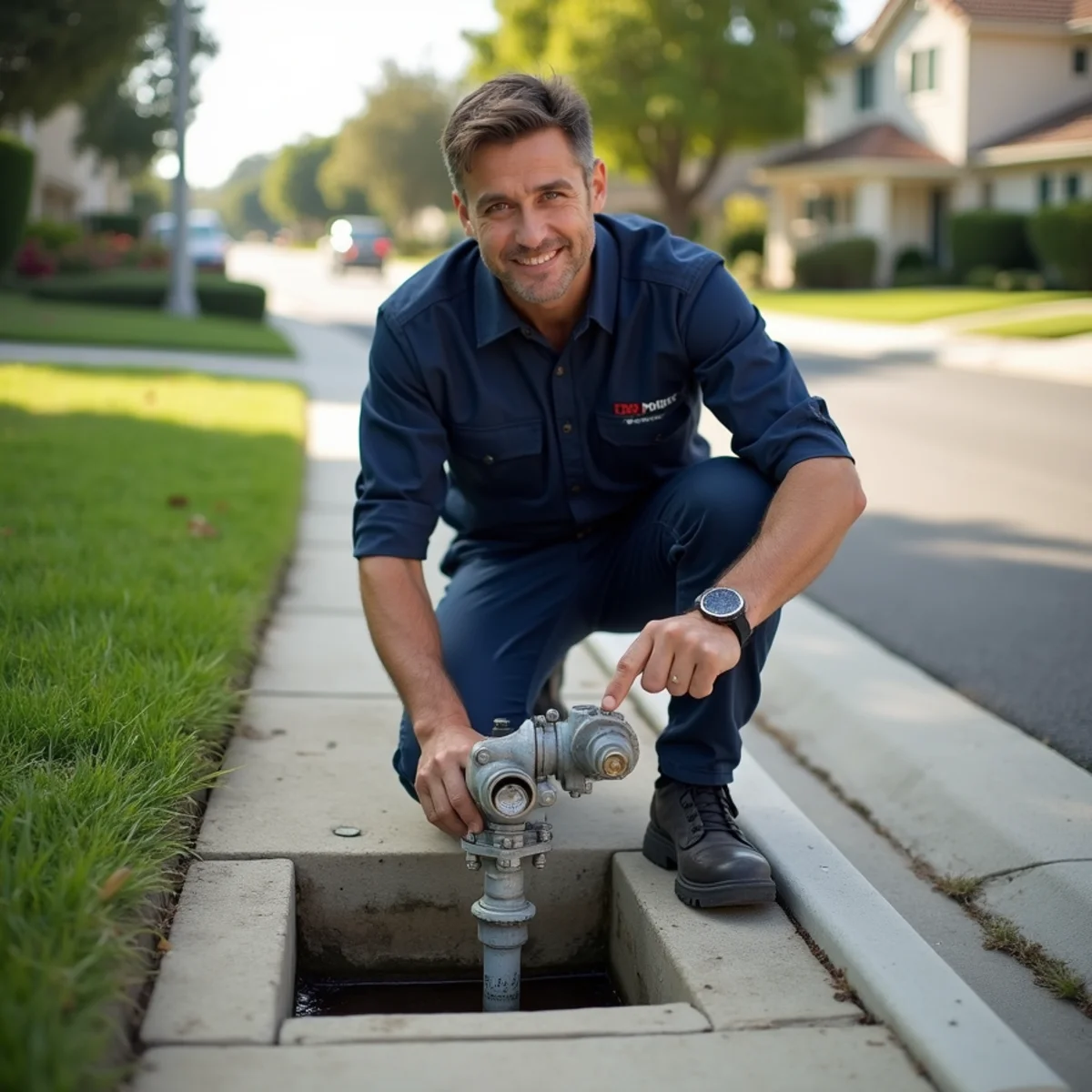
1. The street-side meter box
A rectangular concrete or plastic lid set flush in the ground, usually in the parkway strip between the sidewalk and the street, or just inside the property line. It often has "WATER" cast into it.
Lift the lid — a screwdriver in the notch helps, and check for spiders before you reach in.
Inside you'll see the meter and, typically, a valve on the street side (the utility's, sometimes needing a special key) and one on the house side (yours). The house-side valve is the one you want.
2. Near the front hose bib
Many homes have a shut-off on the exterior wall, usually on the side of the house facing the street, near or below the front hose bib. Look for a round wheel handle or a lever on the pipe coming out of the ground.
3. In the garage
On homes where the supply enters through the garage, look on the wall shared with the front of the house — often near the water heater, sometimes behind stored boxes, occasionally inside an access panel.
If you've searched all three and found nothing, check inside a utility closet or under the kitchen sink on some older properties. And if you genuinely can't find it, your water district can tell you — that's a much better phone call to make on a Tuesday than during an emergency.
How to actually turn it
Round wheel handle (gate valve): turn clockwise, and keep going. These take several full rotations to close. They're also the type most likely to seize after years of no use.
Lever handle (ball valve): a quarter turn. When the lever is parallel to the pipe, it's open. Perpendicular to the pipe, it's closed. Much more reliable and much less likely to stick.
If it won't budge: don't force it hard enough to snap the stem — a broken valve on a live main is worse than the leak you were trying to stop. A gentle back-and-forth sometimes frees it. If not, that valve needs replacing, and it's worth doing before you need it.
Test it now, not later
Turn it fully off. Then go inside and open a faucet. The flow should die within a few seconds.
If water keeps running, the valve isn't sealing — which is exactly what you want to know now rather than during a flood.
Turn it back on slowly. Opening a main quickly sends a pressure surge through the system that can dislodge sediment or damage fittings. Then run a couple of faucets for a minute to clear any air.
Make it findable in the dark
Three small things that make a real difference at 2 a.m.:
Label it. A weatherproof tag or a paint mark. If it's in a meter box, a bright zip tie on the valve.
Leave the tool there. If the box lid needs a screwdriver or the valve needs a meter key, keep one in the garage in a known place, or buy a meter key for a few dollars and hang it inside the box lid.
Tell everyone. Your partner, your teenagers, anyone who house-sits. A photo in the family group chat takes thirty seconds and means whoever is home can act.
The fixture-level valves matter too
The main isn't always the fastest option. Every fixture in your house should have its own local shut-off:
- Under each sink: two angle stops, hot and cold
- Behind each toilet: one angle stop on the wall
- Behind the washing machine: two valves or a single lever box
- At the water heater: a valve on the cold inlet at the top of the tank
- At the refrigerator: usually a small valve behind the unit or under the sink
If the failure is under a bathroom sink, closing that angle stop takes five seconds versus a walk to the street.
Two warnings about angle stops. They're the most likely valve in your house to fail, because they're small and never used — so test each one occasionally. And the older multi-turn type frequently seizes; the quarter-turn ball type is far more reliable and cheap to swap.
Homes where this matters most
Anywhere with aging supply plumbing — the pre-1960 stock across Upland, Ontario and Pomona where original galvanized is corroding from the inside, and the 1980s–90s slab-era tracts across Rancho Cucamonga where in-slab copper is reaching pinhole age.
Anywhere with upstairs plumbing. A second-floor failure damages two floors and the ceiling between them. Minutes matter more.
Anywhere people travel. The worst losses we see are the ones that ran for days in an empty house. If you travel regularly, closing the main when you leave is free, and an automatic shut-off valve tied to leak sensors is the next step up.
We're based in Los Osos and most of Rancho Cucamonga is inside a sixty-minute dispatch — but no response time beats a valve you can close yourself in the first thirty seconds.
The two-minute version
Find it. Turn it. Confirm the water stops. Label it. Leave the tool there. Tell your household.
That's the whole job, and it's the highest-value ten minutes you'll spend on your house this year.
If something's already running, call +1 (201) 277-9344 — we'll walk you to your valve on the phone while a crew is on the way.
FAQ
Questions people also ask
Where is the main water shut-off in most Rancho Cucamonga homes?
Usually one of three places: a concrete meter box in the parkway near the street, on the exterior wall near the front hose bib, or in the garage on the wall shared with the front of the house. If you can't find it, your water district can tell you — and that's a much better call to make on a Tuesday than during an emergency.
Which way do I turn the valve?
A round wheel handle turns clockwise and takes several full rotations. A lever handle is a quarter turn — parallel to the pipe means open, perpendicular means closed. Don't force a seized valve hard enough to break the stem; a snapped valve on a live main is worse than the leak.
Should I turn the water off when I go on vacation?
Yes, for anything longer than a couple of days. The most expensive losses we see are the ones that ran unattended for a week. If you travel often, an automatic shut-off valve paired with leak sensors does it for you and pays for itself the first time it works.
What if the valve is stuck and will not turn?
Do not force it — an old gate valve can snap off in your hand, which turns a controllable problem into an uncontrollable one. If it will not move with reasonable pressure, use the street-side shut-off at the meter instead, which is what the meter key is for. Then have the house valve replaced; a seized main is the single worst thing to discover during an actual emergency.
Services mentioned
- Emergency Water RemovalOne number, answered by a person, any hour of any day — with a truck rolling before the call ends.
- Burst Pipe CleanupA failed supply line can put hundreds of gallons into your house in an hour. We stop it, pull it out and dry it.
- Leak DetectionThermal imaging, acoustic listening and moisture meters find the leak before we open anything up.
Keep reading
Emergency Guides
Dishwasher Leaked Overnight and Flooded the Kitchen — Now What?
The visible puddle is the least of it. Water under cabinets and beneath floating floors is where dishwasher leaks actually do damage.
6 min read
Emergency Guides
Standing Water in the House: Is It Safe to Stay, and Who Do You Call First?
Three questions decide it: is the electricity safe, what's in the water, and is the structure sound. Work through them in order.
5 min read
Emergency Guides
Washing Machine Supply Line Burst: 5 Steps to Limit the Damage
Shut it down, find where the water actually went, and understand why this failure so often happens when nobody is home.
5 min read