
24/7 Emergency Service
Storm Damage Cleanup & Restoration in Rancho Cucamonga, CA
Emergency tarping, water extraction and full interior restoration after Santa Ana winds and winter atmospheric rivers.
- Documented dry standard
- Bonded & insured
- 24/7 emergency response
Storm damage here comes in two flavors, and they arrive in the same season. Santa Ana winds tear open the roof between October and March; the winter storms that follow send water through the opening.
We do both halves: emergency tarping to stop the intrusion, then the interior drying and rebuild. Call +1 (201) 277-9344 — we work through storm nights.
Water actively spreading? Call now — every hour widens the damage and the bill.
+1 (201) 277-9344Do you need this service?
Storm damage that needs a same-day response
After a wind event, the damage that costs the most is usually the damage nobody looked for.
Missing or shifted roof tiles and shingles
Concrete tile is common across Rancho Cucamonga's post-1985 tracts. Wind lifts and cracks it, and the underlayment beneath is what's actually keeping water out.
Damaged flashing, vents or ridge caps
The most common wind failure and the one homeowners never see. Water enters at these points and tracks along framing before appearing anywhere visible.
A new ceiling stain after a storm
The leak is rarely directly above the stain. Water travels along rafters and truss chords before it drops.
Wind-driven rain around windows and doors
Horizontal rain gets past seals that handle vertical rain fine. Look for staining at sill corners and under thresholds.
Tree limbs down on the roof or against the structure
Impact damage plus a water entry point. Get it tarped before the next band of rain arrives.
Runoff that came in at ground level
Water under a garage door or through a slider is a [flood cleanup](/flood-cleanup/) scope — treat it as contaminated.

Santa Ana season is a roofing event, not a wind event
From October through March, offshore pressure gradients push dry air down through the Cajon Pass and out across the valley floor. The National Weather Service issues advisories for this zone regularly through the season, and Rancho Cucamonga's northern neighborhoods sit right in the path.
The relevant fact for your house: gusts don't have to remove roofing to cause a leak. They only have to lift it. A tile that gets lifted and reseats slightly out of position, a piece of ridge flashing that gets bent, a vent boot that cracks — none of it looks like damage from the ground. Then the first atmospheric river of the season arrives in December and water enters through an opening that has been there for two months.
Exposure isn't uniform. The foothill neighborhoods take the worst of it: Etiwanda and North Etiwanda, Deer Creek, and across the line into north Fontana at Hunter's Ridge, which sits closest to the Cajon Pass funnel.
Then the rain arrives all at once
Rancho Cucamonga averages roughly 17.7 inches of rain a year, and nearly all of it falls between November and March. That's not gentle distribution — it arrives in a handful of large events onto ground that's been dry for eight months and doesn't absorb well.
The result is a two-part storm loss: water coming through the roof from above, and runoff pressing against the house at ground level. Both often on the same night. Tropical Storm Hilary in August 2023 showed the county what happens when that much water arrives outside the normal season — over a foot of rain in the mountains and flooding in places that had never taken water before.
What we do first: stop the water coming in
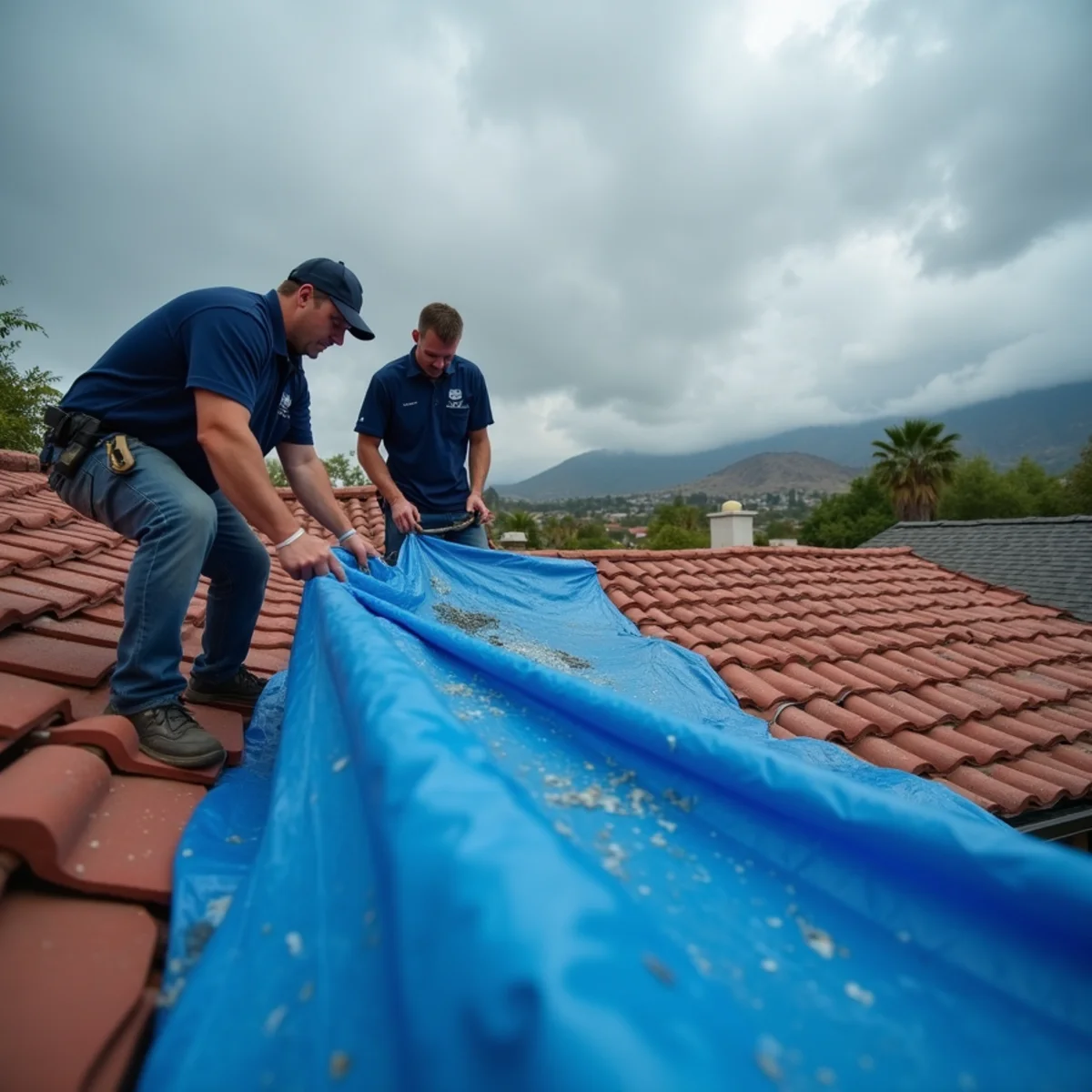
Emergency tarping. Roof tarps get installed and properly secured — battened down, not weighted with sandbags that shift in the next gust. This buys the weeks it may take to get a roofer scheduled after a regional wind event, when every roofing company in the Inland Empire is booked.
Board-up. Broken windows, damaged sliders and compromised openings get secured against both weather and entry.
Debris removal. Downed limbs and displaced material are cleared from the roof and the affected area so the tarp can seat and the crew can work safely.
Water extraction. Everything that came in gets pulled out — attic insulation, ceiling cavities, the rooms below. See water extraction.
Then the part most companies skip: the attic
After a roof intrusion, the interior damage is usually only half the story.
Wet blown-in or batt insulation loses its R-value permanently and holds moisture against the ceiling drywall and framing for weeks. It has to come out — not be dried in place. The framing above the ceiling gets metered and dried directly, which often means access from the attic rather than opening finished ceilings from below.
Skipping the attic is the most common reason a "repaired" storm leak produces a mold problem two months later, and it's why we go up there on every roof-origin loss.
Working with your carrier on a storm claim
Wind damage is a covered peril on standard California homeowners policies, and water that enters through a wind-created opening is generally covered as a consequence of that wind damage. That causal chain — wind first, then water — is the whole claim.
Which means documentation matters enormously here. We photograph the roof damage, the entry point, the path the water took, and the interior damage as a sequence. When your adjuster asks whether this was storm damage or a pre-existing maintenance issue, that sequence is the answer.
Two practical notes. Get the tarp on before the next storm — a carrier can reduce a claim for damage that occurred after you had the opportunity to mitigate. And keep the emergency service invoices; emergency mitigation is typically reimbursable separately from the repair scope.
Related: Santa Ana wind roof leaks and what Tropical Storm Hilary taught San Bernardino County.
Ground-level intrusion: the other half of storm season
Roof and attic work is the visible half of what we do in a storm. The other half arrives at floor level, and it behaves completely differently.
How it gets in. Almost never because a flood control channel or a debris basin was overwhelmed — that infrastructure generally does its job. It gets in because of on-site drainage: grading that has settled so it now falls toward the house, downspouts discharging beside a foundation instead of clear of it, yard and area drains silted up after eight dry months, retaining wall weep holes plugged with soil, and hardscape that redirects sheet flow toward a low opening. The entry point is usually a garage threshold, a side-yard slider or a lower-level door.
Why it is a different job. Water that has crossed soil, landscaping and paving is contaminated by the time it is indoors — Category 3, regardless of how clear it looks. That changes the protocol from a clean-water dry-out to a flood cleanup: porous materials below the water line come out rather than being dried, what remains gets antimicrobial treatment, and disposal is controlled.
Why the cause has to be documented immediately. Surface water entering from outside is commonly excluded from standard homeowners policies and sits with flood cover instead, while damage from a failure of your own plumbing or drainage is treated differently. That determination turns on where the water came from and the path it took — which is only provable from photographs of the entry point and the water line taken before anything is moved.
What we leave you with. A written list of what actually let it in, so the correction happens before the next storm rather than after it.
Our process
How storm damage cleanup works, step by step
Emergency stabilisation
Roof tarping, board-up and debris clearing — the priority is stopping further intrusion before the next band of weather.
Full damage survey
Roof, attic, ceilings, walls and ground level are all inspected. Storm water rarely damages only what's visible from inside.
Sequenced documentation
Wind damage, entry point, water path and interior damage photographed as a causal chain — that sequence is what a storm claim rests on.
Extraction and insulation removal
Standing water comes out and saturated attic insulation is removed rather than dried in place.
Structural drying
Framing, ceiling assemblies and affected rooms dried to a documented standard with daily readings.
Interior rebuild and roofer coordination
Drywall, texture, paint and insulation restored, coordinated around the permanent roof repair.
- Documented dry standard
- Bonded & insured
- 24/7 emergency response
What it costs
What moves the price on a job like this
We won't quote your property over the phone — too many variables. Here's what an honest estimate is built from.
- 1
Size and location of the intrusion
A single cracked vent boot over a hallway versus wind damage across a whole roof plane are entirely different interior scopes.
- 2
Attic involvement
Removing and replacing saturated insulation, and drying framing from above, is one of the larger cost drivers on storm losses.
- 3
Emergency tarping and duration
Tarp size, roof pitch and how long temporary protection needs to stay on before the roofer can get there.
- 4
Ceiling and finish damage
Textured and vaulted ceilings cost more to repair and match than flat drywall, and often require repainting the full plane.
- 5
Ground-level water
If runoff also entered at ground level, that portion is treated as contaminated and carries flood-cleanup protocols.
The on-site assessment and written estimate are free. See our Rancho Cucamonga, CA cost guide for typical ranges.
Why RC Water Pros
Why Rancho Cucamonga homeowners call us for this
Five things we commit to on every job, before we ever pull into your driveway.
60-minute dispatch, from inside the city
Our crews and equipment stage off 11190 White Birch Dr in Rancho Cucamonga — not a regional hub an hour away. On storm damage cleanup that arrival gap is the difference between drying in place and demolition.
Every job run to the published S500 standard
Every job is run to the published industry standard for water damage restoration, with a documented dry standard established from your own unaffected materials — not a technician's judgement about what feels dry.
Adjuster-ready documentation on every job
Timestamped photos, moisture maps, daily drying logs, equipment run hours and a written scope, delivered in the format carriers expect. We speak to your adjuster directly so you aren't the middleman.
Extraction through rebuild, one contract
We don't dry your property and hand you a list of subcontractors. The crew that dries it puts the drywall, texture, paint, baseboard and flooring back, under one point of contact.
Free assessment and a written estimate
Free on-site assessment and written estimate, no charge to come and look, and a straight answer about whether the job is small enough for you to handle yourself.
FAQ
Storm Damage Cleanup questions
Do you tarp roofs, or just clean up inside?
Both. Emergency tarping and board-up are part of the same call — there's no point extracting water while more is coming in. We install properly secured tarps that hold through the rest of the storm season if a roofer can't get out for weeks.
Does insurance cover storm damage in Rancho Cucamonga?
Wind damage is a covered peril on standard California homeowners policies, and water entering through a wind-created opening is generally covered as a consequence. What's typically not covered is water that came in at ground level as surface runoff — that falls under flood insurance. Because the distinction is everything, we photograph the entry point and the causal sequence before any cleanup starts.
The wind was two months ago and I've only just found a leak. Is it too late?
No, and it's an extremely common sequence here — wind lifts the roofing in October, the first real rain arrives in December, and that's when you find out. Photograph everything, report it promptly once discovered, and we'll document the wind-origin damage as part of the file.
Should I get on the roof to look after a wind event?
Please don't. Post-storm roof falls are a genuine hazard, tile is easy to crack further by walking on it, and most wind damage — lifted tile, bent flashing, cracked boots — isn't identifiable from the surface anyway. We inspect it, and so will your roofer.
How quickly can you tarp a roof after a storm?
Same day in most cases, and we prioritise tarping over everything else on the job, because there's no point extracting water while more is coming in. During a major regional wind event every restoration and roofing company in the Inland Empire is working simultaneously, so calling early genuinely matters. A properly battened tarp will hold through the rest of the season, which is what buys you time when roofers are booked out for weeks.
Storm water got into the house. Is that covered by our policy?
It depends on the policy wording and on how the water arrived, and it is the single most common coverage surprise we see. Surface water entering from outside is commonly excluded from standard homeowners cover and generally falls under flood insurance instead; damage originating from your own plumbing or a roof opening is usually treated differently. We document the origin, the entry point and the water line precisely so the question is answered from evidence rather than argued from recollection.
Related services
- Roof Leak DamageWind lifts the tile in October, the December storm finds the gap. We tarp, strip wet insulation and dry the structure.
- Flood CleanupStorm and runoff flooding brings contaminated water. We pump, strip, sanitize and dry — then document it for your carrier.
- Ceiling Water Damage RepairFind the actual leak, dry the cavity above, then repair and texture-match — not just paint over the stain.
Further reading

Local Risk & Rancho Cucamonga
Santa Ana Wind Season (Oct–Mar): How Cajon Pass Gusts Turn Into Roof Leaks in Etiwanda and North Fontana
Gusts don't have to remove a roof to cause a leak. They only have to lift it — and the leak shows up two months later.
5 min read

Local Risk & Rancho Cucamonga
What Tropical Storm Hilary Taught San Bernardino County About Flash Flooding
An August storm delivered a winter's rain in a day, in places with no flood history. Here's what it exposed.
5 min read
Where we work
Storm Damage Cleanup across the Inland Empire
Based in Rancho Cucamonga, serving the surrounding cities and neighborhoods 24/7.
Need storm damage cleanup in Rancho Cucamonga?
Free assessment, 60-minute dispatch, and a real person on the phone at any hour.
- Documented dry standard
- Bonded & insured
- 24/7 emergency response