

60-Minute Dispatch · 24/7
Water Damage Restoration in Hunter's Ridge, Fontana, CA
Premium foothill tracts feeding Etiwanda schools, with the highest Cajon Pass wind exposure in the region — Santa Ana roof and shingle water entry.
- Documented dry standard
- Bonded & insured
- 24/7 emergency response
Hunter's Ridge sits at the top of north Fontana, up against the foothills and close to the mouth of the Cajon Pass. It's a premium area — larger homes, good schools, and views.
It also takes the strongest sustained wind in our entire service area, and that single fact drives most of what we get called for here.
Local risk profile
Why homes in Hunter's Ridge take water damage the way they do
The Cajon Pass is a wind funnel. When offshore pressure gradients set up between October and March, air accelerates through the gap and spreads across the north end of the valley. Hunter's Ridge is among the first neighborhoods it reaches.
The damage is rarely dramatic. Gusts don't need to strip a roof to cause a leak — lifting is enough. A concrete tile that gets lifted and reseats slightly proud. A section of ridge flashing that bends. A vent boot that cracks. A run of underlayment that tears at a fastener. None of it is visible from the ground and none of it leaks in October, because it doesn't rain in October.
Then the first atmospheric river arrives in December and water enters through a gap that has been open for two months. That delay is why homeowners here often can't connect a leak to a wind event, and it's why we document wind-origin damage carefully — the causal chain matters for the claim.
The housing is newer, largely late-1990s through 2010s, so supply plumbing isn't the issue. What is: attic assemblies that stay wet after a roof intrusion, and the substantial square footage of blown-in insulation that has to come out once saturated.
On the ground
What our Hunter's Ridge jobs actually look like
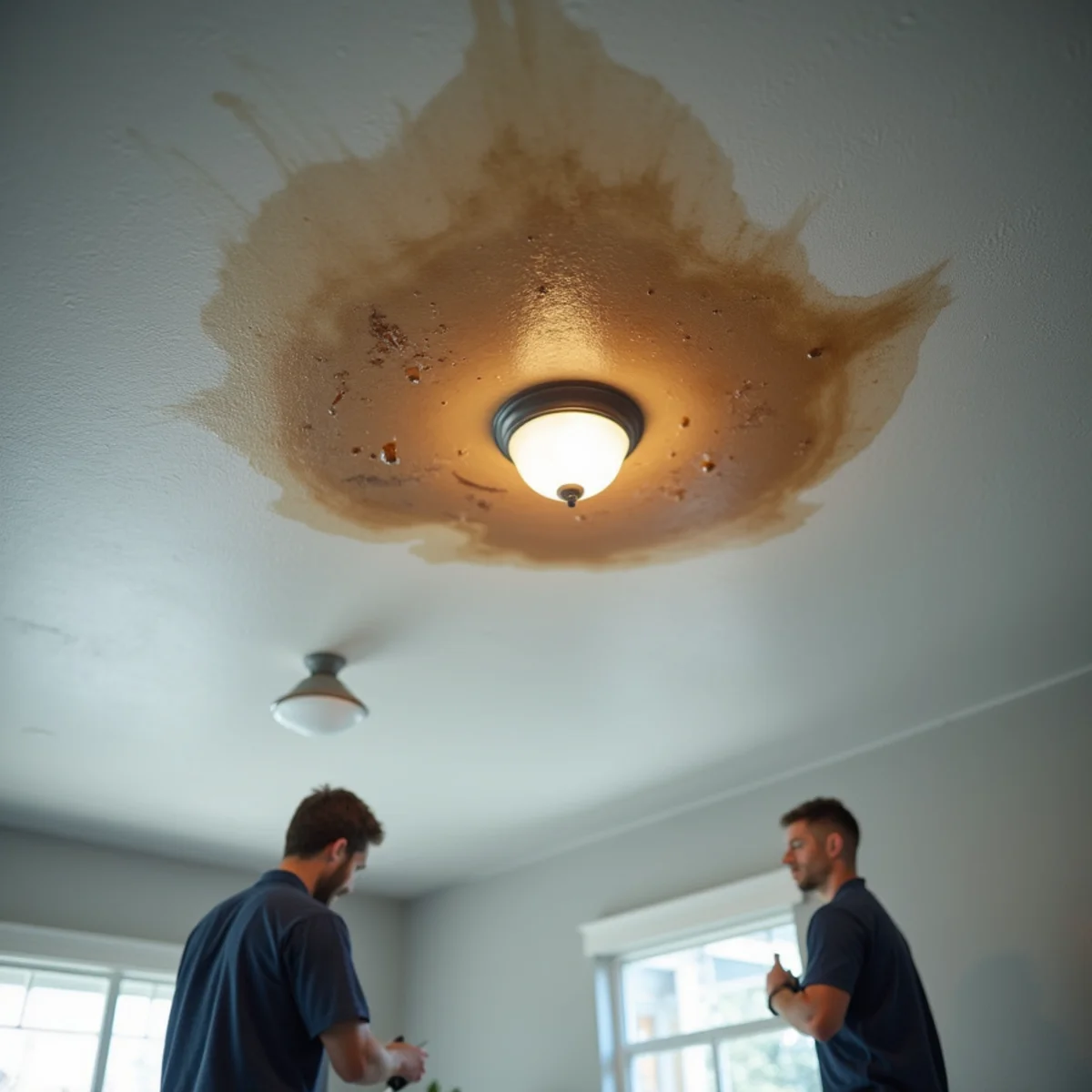
A typical Hunter's Ridge job starts with a ceiling stain in December from wind damage that occurred in October.
The work is mostly above the ceiling. We tarp the roof so the intrusion stops that night, then get into the attic: trace the water back along the framing to the actual entry point, remove the saturated blown-in insulation, meter and dry the sheathing and truss chords directly, and check for growth if it's been running through more than one storm. Then the ceiling repair, texture and paint.
The permanent roof repair is a roofer's job, and after a regional wind event every roofer in the Inland Empire is booked for weeks — which is exactly why a properly battened tarp matters rather than a sandbagged sheet of plastic.
Our practical advice for this neighborhood: have the roof looked at after a significant wind event rather than after the first storm. Finding a lifted tile in November costs a service call. Finding it in January costs an attic.
We work around
- Hunter's Ridge trails
- Sierra Avenue
- Duncan Canyon Road
- Etiwanda school boundary
Why Hunter's Ridge
Why Hunter's Ridge residents call us
We stop the intrusion the same night, properly. After a regional wind event every roofer in the Inland Empire is booked out for weeks, so the tarp is not a formality — it is the only thing standing between your attic and the next storm. Ours get battened to the deck and lapped over the ridge, not weighted down with sandbags and left to flap.
We work above the ceiling, not just at it. The stain on your ceiling is the end of the water's journey, not the start. We get into the attic, trace it back along the truss chords to the actual entry, and meter the sheathing and framing directly. Patching a ceiling under a wet attic is how a repaired room turns into a mould call in March.
We write the wind-to-leak chain out for your carrier. October gusts, a lifted tile that sat open through a rainless autumn, a December atmospheric river — that sequence is obvious to us and invisible to an adjuster reading a one-line loss description. We photograph the lifted component, the entry point and the water path as one connected record.
We size drying for the attic volume, not the room. These are large foothill homes with substantial attic space and deep blown-in insulation. Once that insulation is saturated it comes out; once it is out, the cavity we are drying is far bigger than the floor plan suggests, and the equipment has to match it.
What we do here
Services we run most in Hunter's Ridge
Chosen from what this area's housing and geography actually produce — not a generic list.
Roof Leak Damage
Wind lifts the tile in October, the December storm finds the gap. We tarp, strip wet insulation and dry the structure.
Learn moreStorm Damage Cleanup
Emergency tarping, water extraction and full interior restoration after Santa Ana winds and winter atmospheric rivers.
Learn moreCeiling Water Damage Repair
Find the actual leak, dry the cavity above, then repair and texture-match — not just paint over the stain.
Learn moreMold Remediation
Containment, HEPA filtration, source removal and moisture correction — remediation that fixes the cause, not just the stain.
Learn moreStructural Drying
Air movers and commercial dehumidifiers placed to a calculated load, with daily moisture readings you get to see.
Learn more
- Documented dry standard
- Bonded & insured
- 24/7 emergency response
FAQ
Water damage questions from Hunter's Ridge
The wind was months ago. How is that the cause of a leak now?
It's the standard sequence up here. Santa Ana gusts lift tile and bend flashing in the fall, the opening sits dry through a rainless autumn, and the first real storm in December pushes water through it. We document the wind damage, the entry point and the water path as a causal chain, because that's what supports the claim.
Does the attic insulation really have to come out?
If it's saturated, yes. Blown-in insulation loses its R-value permanently once soaked and holds moisture against your ceiling drywall and framing for weeks afterward — which is the most common reason a repaired ceiling grows mold a couple of months later. Damp at the edges can sometimes be dried; soaked cannot.
How fast can you get to Hunter's Ridge in a storm?
Fifteen to twenty minutes east along the 210 in normal conditions, and we dispatch around the clock. Storm nights are the exception everywhere — when a system is sitting over the valley, calls stack up region-wide. Calling early rather than waiting to see whether the drip gets worse is what actually protects your position in the queue.
Should we get the roof inspected before winter?
In this neighbourhood, yes — and specifically after a significant wind event rather than after the first rain. Finding a lifted tile in November costs a service call. Finding the same tile in January, after water has run through the attic insulation for two storms, costs an attic.
Further reading
Useful for Hunter's Ridge homeowners

Local Risk & Rancho Cucamonga
Santa Ana Wind Season (Oct–Mar): How Cajon Pass Gusts Turn Into Roof Leaks in Etiwanda and North Fontana
Gusts don't have to remove a roof to cause a leak. They only have to lift it — and the leak shows up two months later.
5 min read
Emergency Guides
Ceiling Leaking During a Storm? What to Do in the Next 30 Minutes
Clear the room, kill the circuit, catch what you can — and why the leak is almost never directly above the stain.
5 min read
Nearby
Other areas we serve close to here
Same crews, same response, same documentation.
Get in touch
Serving Hunter's Ridge, Fontana from our Rancho Cucamonga base
RC Water Pros
Water Damage Restoration · Rancho Cucamonga, CA
- 11190 White Birch Dr
Rancho Cucamonga, CA 91730 - +1 (201) 277-9344
- Emergency response 24 hours a day, 7 days a week
Office & estimates: Mon–Sat, 7:00 AM – 7:00 PM
Water damage in Hunter's Ridge? We're already close.
East along the 210 — about 15 to 20 minutes from our Rancho Cucamonga base. Free assessment, 24/7 dispatch, and we handle your insurance documentation.
- Documented dry standard
- Bonded & insured
- 24/7 emergency response