

Free Written Estimate
Roof Leak Water Damage Restoration in Rancho Cucamonga, CA
Wind lifts the tile in October, the December storm finds the gap. We tarp, strip wet insulation and dry the structure.
- Documented dry standard
- Bonded & insured
- 24/7 emergency response
Roof leaks in Rancho Cucamonga run on a schedule. Santa Ana winds open the roof between October and March; the winter storms that follow put water through the opening. By the time a stain appears on your ceiling, the attic above it has usually been wet for a while.
We tarp it, deal with the attic, and restore the interior. Call +1 (201) 277-9344.
Water actively spreading? Call now — every hour widens the damage and the bill.
+1 (201) 277-9344Do you need this service?
How a roof leak shows up
Rarely as dramatic dripping. Usually as something subtle in a place you don't look often.
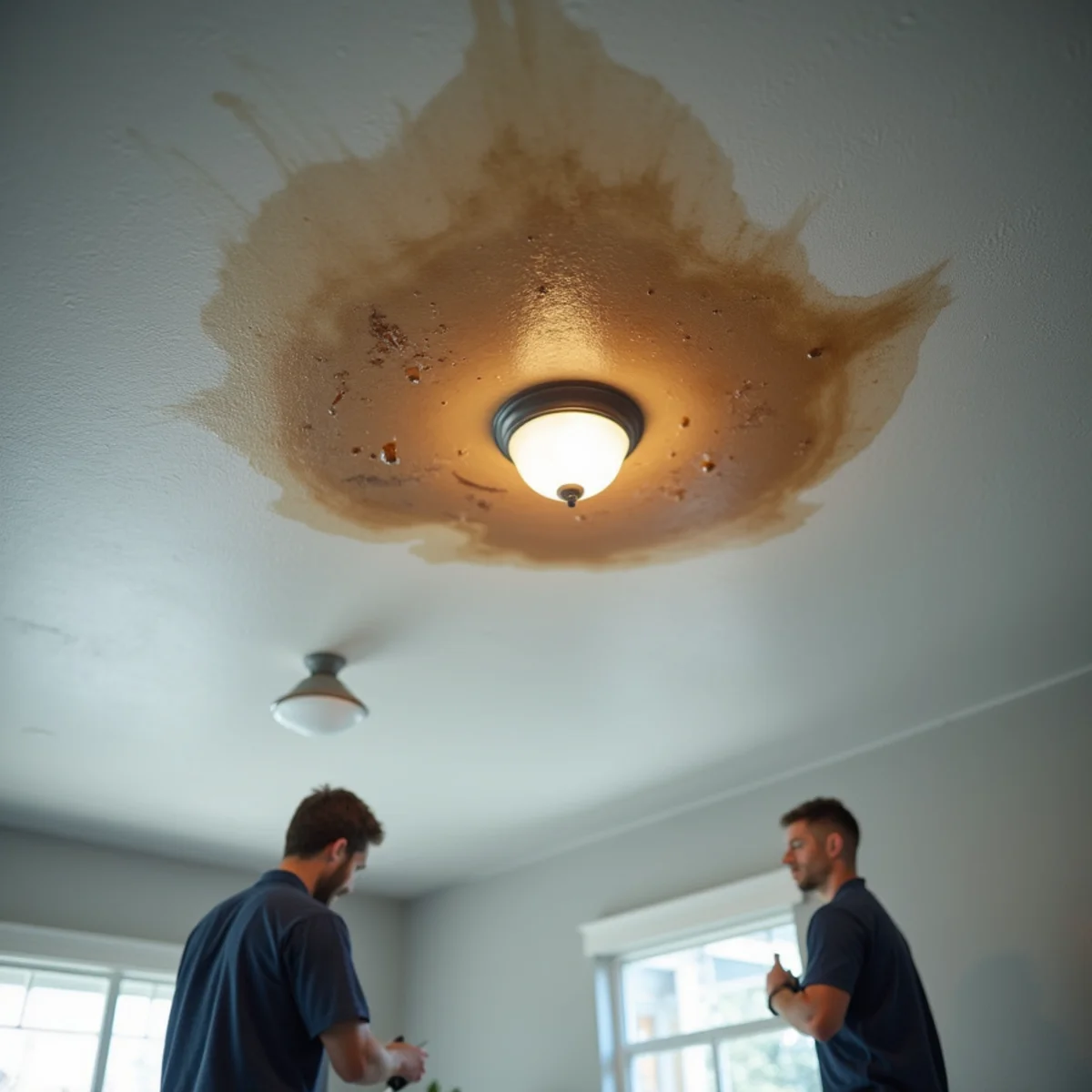
A ceiling stain that appears after rain
The most obvious sign, and usually not directly below the entry point — water travels along framing before it drops.
Compressed, dark or fallen attic insulation
Look with a flashlight from the hatch. Insulation that has been wet mats down and darkens, and it never recovers its R-value.
Water staining on rafters or the underside of sheathing
Dark tide marks on the wood. Visible from the attic long before anything reaches your ceiling drywall.
Damp or musty smell in an upstairs room
A slow roof leak into a wall cavity produces odor before it produces a stain.
Cracked, slipped or missing tile visible from the ground
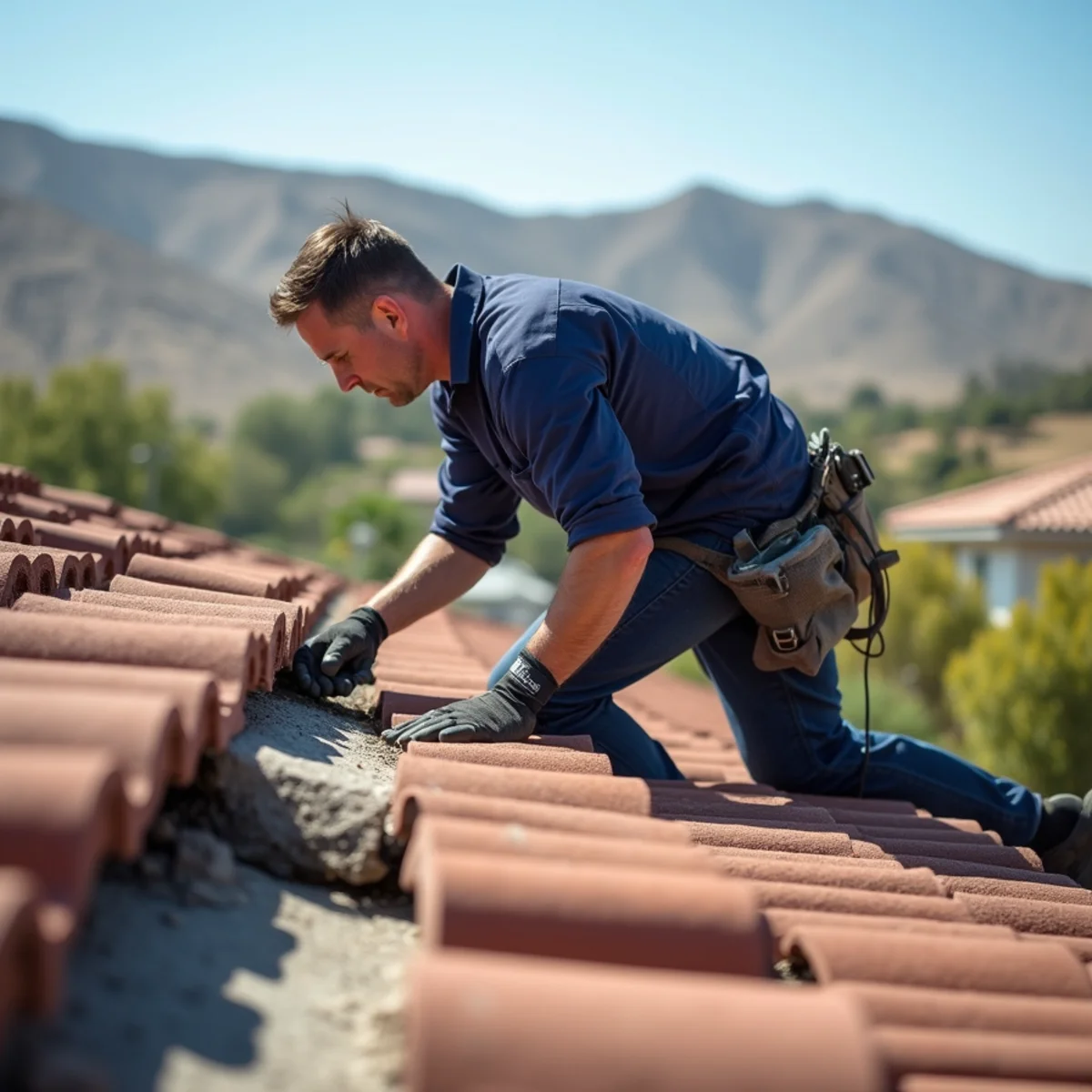
Common after a wind event. Concrete tile is brittle and its job is partly to protect the underlayment beneath it.
Staining where a wall meets the roof or around a chimney
Flashing failure. These transitions are where the majority of roof leaks actually originate.

Tile roofs don't work the way people think
Most of Rancho Cucamonga's post-1985 housing has concrete tile. Homeowners generally assume the tile keeps the water out.
It doesn't, entirely. The tile is the first layer — it sheds the bulk of the water and protects what's underneath from sun. The actual waterproofing is the underlayment, the felt or synthetic membrane laid over the sheathing. Underlayment has a service life, typically shorter than the tile above it, and it degrades from UV and heat every year it's exposed at the edges.
Two consequences follow. First, a cracked or slipped tile isn't cosmetic — it exposes underlayment to direct sun and impact, and accelerates its failure. Second, a roof can be "in good condition" from the street and still be at the end of its waterproofing life, which is why the Terra Vista and Victoria-era tracts built in the late 80s and 90s are hitting first-cycle underlayment replacement now.
Santa Ana winds and the delayed leak
Between October and March, offshore winds funnel through the Cajon Pass and across the valley. They don't need to remove roofing to cause a leak — lifting is enough. A tile gets lifted and reseats slightly proud. Ridge flashing bends. A vent boot cracks. A section of underlayment tears at a fastener.
None of that is visible from the ground, and none of it leaks in October, because it doesn't rain in October.
Then the first atmospheric river arrives in December, and water goes through the opening that's been sitting there for eight weeks. That gap between cause and symptom is why homeowners often can't connect the leak to a wind event — and why we document it as wind-origin damage when the evidence supports it, because that distinction matters to your claim.
Highest exposure is the north end: Etiwanda, North Etiwanda, Deer Creek, and neighboring Hunter's Ridge in north Fontana, which sits nearest the pass.
The attic is the job
This is where roof-leak restoration is won or lost, and it's the step most commonly skipped.
Wet insulation comes out. Blown-in cellulose and fiberglass batt both lose their R-value permanently once saturated, and they hold moisture against your ceiling drywall and framing for weeks afterward. Drying it in place is not a real option. It gets removed, bagged and replaced.
The framing gets metered and dried directly. Rafters, truss chords and the underside of the sheathing are read with a moisture meter and dried with directed airflow from inside the attic — not by pointing fans at the ceiling from the room below.
The cavity gets inspected for growth. A leak that's been running through two storms has usually had enough time. If there's growth on the sheathing, that's a mold remediation scope with containment before anything else.
If someone repairs your ceiling without going into the attic, they've treated the stain and left the problem.
Our scope, and where the roofer's starts
We handle emergency tarping — properly battened, not sandbagged — so the intrusion stops tonight. We handle the attic, the drying, the ceiling repair, the walls, insulation replacement, texture and paint.
The permanent roof repair is a licensed roofing contractor's work, and we coordinate around their schedule. After a regional wind event every roofer in the Inland Empire is booked for weeks, which is exactly why the tarp matters — a properly installed tarp will hold through the season.
The claim
Wind is a covered peril, and water entering through a wind-created opening is generally covered as a consequence of it. What is generally not covered is a roof that failed from age and wear.
So the documentation is everything: photographs of the physical roof damage, the entry point, the water path through the attic, and the interior damage — presented as a sequence. We also note the storm dates. If your carrier's position is "this is deferred maintenance," that evidence is your answer.
Also worth knowing: most policies pay to repair the damaged portion of the roof, not to replace the whole roof because the new section won't match.
Related: Santa Ana wind roof leaks in Etiwanda and north Fontana and ceiling leaking during a storm.
What a temporary cover has to do to be worth anything
After a regional wind event the roofing trade across this valley books out for weeks, which means the temporary cover is doing weeks of work rather than holding overnight. Most of the failed tarps we are called back to were never going to survive the next system.
The version that fails. A sheet of plastic laid over the damage with a few sandbags on it. Wind gets under an unsecured edge, lifts the whole thing, and it is gone by the next storm — frequently taking more tiles with it on the way.
What a proper temporary cover looks like. Material of a real weight rather than builder's polythene. Run from below the damage up over the ridge wherever the roof geometry allows, so water cannot track underneath from the high side. Edges secured with furring strips screwed through into the deck rather than weighted down. Fasteners placed where the permanent repair will cover them. Laps oriented so water runs over the joins rather than into them.
Why it is worth insisting on. The gap between the emergency and the permanent repair is the whole exposure. A cover that fails in week two puts water into an attic that had started to dry, which turns one wet ceiling into insulation replacement, framing that has now been wet through several cycles, and quite possibly growth.
On going up yourself. A wet tile roof in wind is genuinely dangerous, and walking a tile field breaks more tiles than the wind did. Photograph what you can see from the ground, and leave the rest to someone doing it with fall protection.
Our process
How roof leak damage works, step by step
Emergency tarp
Properly secured roof tarp to stop intrusion before the next band of rain — often days or weeks before a roofer can get on site.
Trace the entry point
Attic inspection and thermal imaging follow the water back along framing to where it actually entered, not where it dripped.
Remove wet insulation
Saturated blown-in or batt insulation is bagged and removed — it doesn't recover, and it holds moisture against your ceiling.
Dry the attic assembly
Rafters, truss chords and sheathing are metered and dried with directed airflow from inside the attic space.
Interior drying and remediation
Ceilings, walls and affected rooms dried to standard, with mold containment first if growth is present.
Rebuild and roofer coordination
New insulation, drywall, texture and paint, sequenced around the licensed roofing contractor's permanent repair.
- Documented dry standard
- Bonded & insured
- 24/7 emergency response
What it costs
What moves the price on a job like this
We won't quote your property over the phone — too many variables. Here's what an honest estimate is built from.
- 1
How many storms it ran through
A leak caught after one event is a contained repair. Three seasons of intermittent wetting usually means growth and a much larger scope.
- 2
Attic insulation area
Removal and replacement of saturated insulation is measured in square footage and is one of the biggest single line items.
- 3
Ceiling type and height
Vaulted or two-story ceilings need staging, and matching heavy sprayed textures takes longer than flat drywall.
- 4
Tarping duration
Tarp size, roof pitch and how long temporary protection must stay in place before permanent repair.
- 5
Whether growth is present
Mold on sheathing or framing adds containment, HEPA filtration and remediation labor before any rebuild starts.
The on-site assessment and written estimate are free. See our Rancho Cucamonga, CA cost guide for typical ranges.
Why RC Water Pros
Why Rancho Cucamonga homeowners call us for this
Five things we commit to on every job, before we ever pull into your driveway.
60-minute dispatch, from inside the city
Our crews and equipment stage off 11190 White Birch Dr in Rancho Cucamonga — not a regional hub an hour away. On roof leak damage that arrival gap is the difference between drying in place and demolition.
Every job run to the published S500 standard
Every job is run to the published industry standard for water damage restoration, with a documented dry standard established from your own unaffected materials — not a technician's judgement about what feels dry.
Adjuster-ready documentation on every job
Timestamped photos, moisture maps, daily drying logs, equipment run hours and a written scope, delivered in the format carriers expect. We speak to your adjuster directly so you aren't the middleman.
Extraction through rebuild, one contract
We don't dry your property and hand you a list of subcontractors. The crew that dries it puts the drywall, texture, paint, baseboard and flooring back, under one point of contact.
Free assessment and a written estimate
Free on-site assessment and written estimate, no charge to come and look, and a straight answer about whether the job is small enough for you to handle yourself.
FAQ
Roof Leak Damage questions
Do you repair the roof itself?
We install the emergency tarp and handle everything the water damaged — attic, insulation, ceilings, walls, drying and rebuild. The permanent roof repair is done by a licensed roofing contractor, and we coordinate our interior work around their schedule.
The wind was months ago and the leak just started. Can I still claim it?
Yes, and it's the normal sequence here — Santa Ana winds lift roofing in the fall, the first real rain arrives in December, and that's when you find out. What matters is reporting promptly once discovered and documenting the wind-origin damage. We photograph the roof damage, entry point and water path as a causal sequence for exactly this reason.
Does the attic insulation really have to be replaced?
If it's saturated, yes. Both blown-in and batt insulation lose R-value permanently once wet, and they hold moisture against your ceiling drywall and framing for weeks — which is the most common reason a repaired ceiling grows mold a couple of months later. Damp-at-the-edges insulation can sometimes be dried; soaked insulation cannot.
How much of the ceiling will need replacing?
Less than most people expect, if we get there before the drywall loses integrity. Staining alone doesn't condemn a ceiling — sagging, delaminated paper facing, or growth on the back does. We meter it rather than guess, and we'll show you the readings.
Can you work in the rain, or do we wait for it to stop?
We tarp in the rain — that's exactly when it matters, and it's the one thing that shouldn't wait. Interior extraction and drying also start immediately, because the water already inside doesn't care what the weather is doing. What does wait is the permanent roof repair and any exterior work, which a roofer needs a dry roof deck for. So the sequence is stop the intrusion now, dry the inside now, repair the roof when the weather allows.
How long can a temporary cover stay on?
A properly battened cover will hold for several weeks and through multiple storms, which is usually enough to bridge the wait for a roofer after a regional event. It is not a permanent repair and it degrades in sun, so it should not become a year-round arrangement. We inspect ours after each significant storm while the job is open, and we tell you plainly when a cover has reached the end of its useful life.
Related services
- Storm Damage CleanupEmergency tarping, water extraction and full interior restoration after Santa Ana winds and winter atmospheric rivers.
- Ceiling Water Damage RepairFind the actual leak, dry the cavity above, then repair and texture-match — not just paint over the stain.
- Mold RemediationContainment, HEPA filtration, source removal and moisture correction — remediation that fixes the cause, not just the stain.
Further reading
Local Risk & Rancho Cucamonga
Santa Ana Wind Season (Oct–Mar): How Cajon Pass Gusts Turn Into Roof Leaks in Etiwanda and North Fontana
Gusts don't have to remove a roof to cause a leak. They only have to lift it — and the leak shows up two months later.
5 min read
Emergency Guides
Ceiling Leaking During a Storm? What to Do in the Next 30 Minutes
Clear the room, kill the circuit, catch what you can — and why the leak is almost never directly above the stain.
5 min read
Where we work
Roof Leak Damage across the Inland Empire
Based in Rancho Cucamonga, serving the surrounding cities and neighborhoods 24/7.
Need roof leak damage in Rancho Cucamonga?
Free assessment, 60-minute dispatch, and a real person on the phone at any hour.
- Documented dry standard
- Bonded & insured
- 24/7 emergency response