Free Written Estimate
Structural Drying & Dehumidification in Rancho Cucamonga, CA
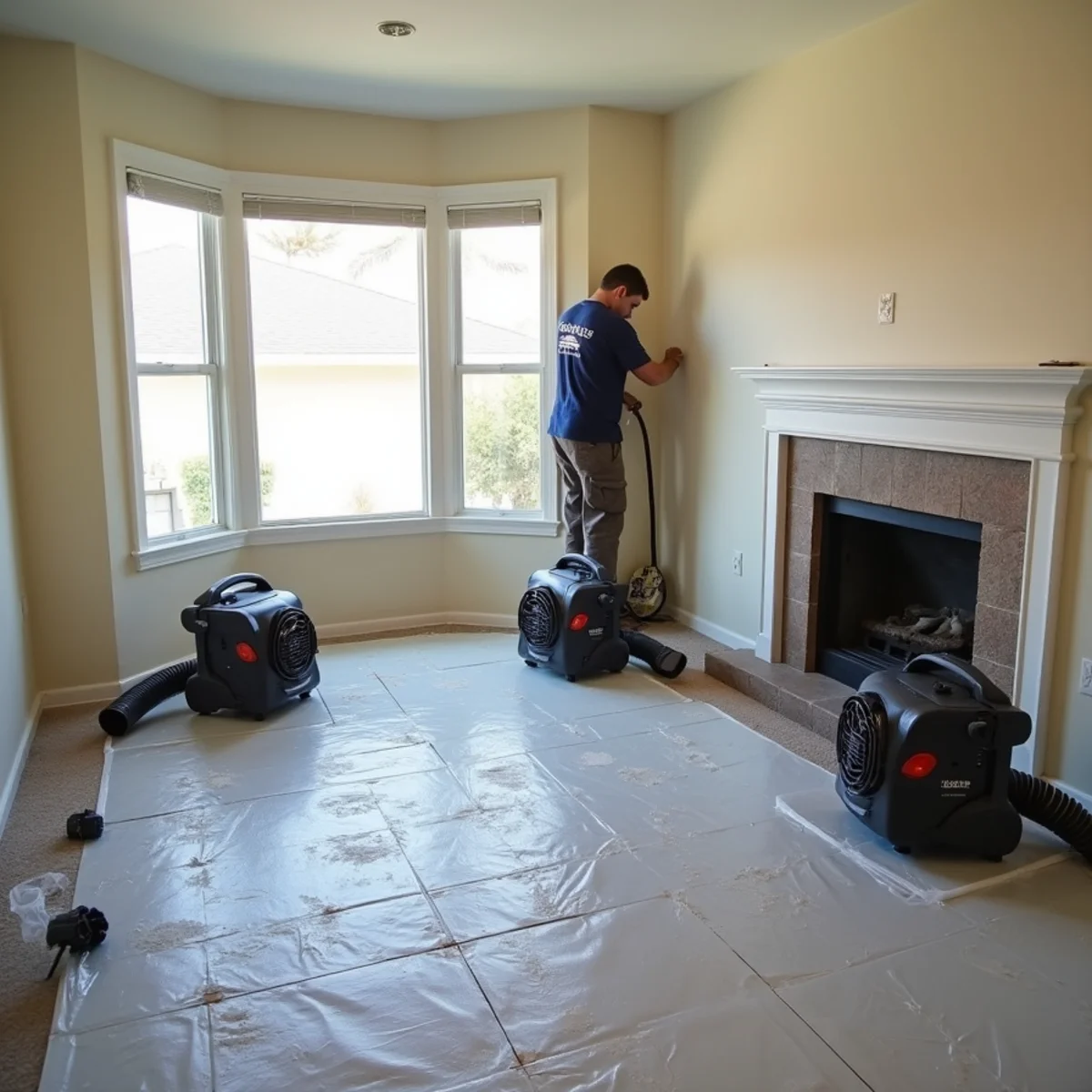
Air movers and commercial dehumidifiers placed to a calculated load, with daily moisture readings you get to see.
- Documented dry standard
- Bonded & insured
- 24/7 emergency response
Extraction gets the water you can see. Drying gets the water that has soaked into the wood, the drywall and the concrete — and that is the part that decides whether you get mold in three weeks.
We dry to a documented standard, not to a feeling, and we read every affected material every day until it hits its target. Call +1 (201) 277-9344 to get equipment on the floor today.
Water actively spreading? Call now — every hour widens the damage and the bill.
+1 (201) 277-9344Do you need this service?
Signs a house was never properly dried
We get called out to a lot of second attempts. These are the tells.
A musty smell that comes back on warm days
Residual moisture in a wall cavity or under flooring re-releases as the house warms. If the smell has a schedule, something is still wet.
Drywall that feels cool or soft near the floor
Cool-to-touch drywall usually means evaporative cooling — active moisture leaving the material.
Baseboards separating or paint bubbling weeks later
Finish failures are a lagging indicator. The substrate behind them has been wet the whole time.
Someone dropped off fans and left
Household or rental box fans move air but add no dehumidification. Without a dehumidifier you're just relocating moisture into other rooms.
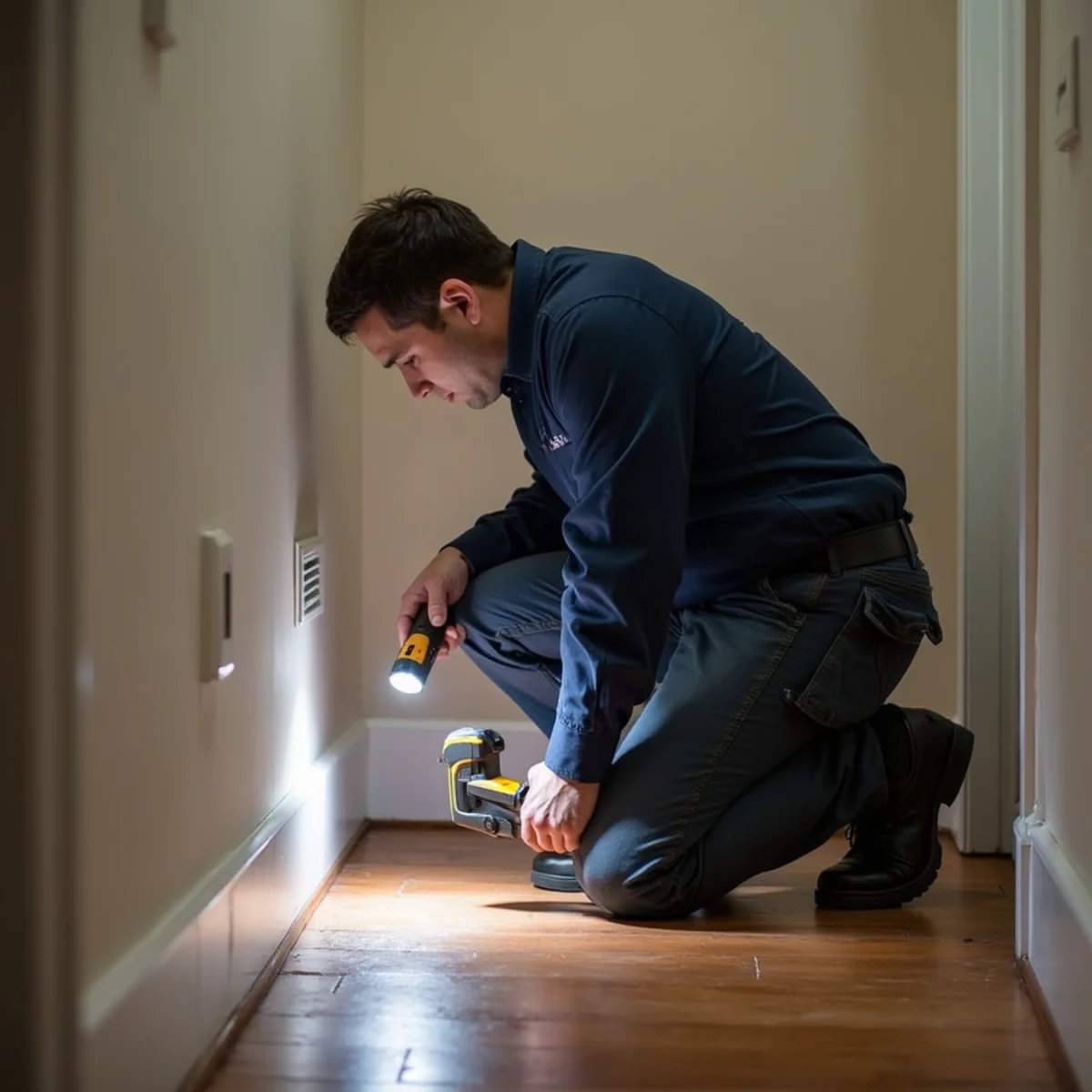
No one took a moisture reading
If nobody produced a number on day one, there is no way to prove the house reached dry. That is also a problem for your claim.

Drying is physics, not equipment count
There's a myth that drying is about how many fans you can fit in a room. It isn't. Drying is about controlling four variables at once — temperature, humidity, airflow and time — so that moisture moves out of materials, into the air, and then out of the air.
Air movers create high-velocity airflow across wet surfaces. That thins the boundary layer of saturated air sitting on the material and lets evaporation continue instead of stalling.
Dehumidifiers then pull that evaporated moisture out of the room air. Without enough dehumidification capacity the air saturates, evaporation stops, and all those fans are just pushing wet air around your house — and into rooms that were dry.
Temperature matters because warm air holds far more moisture than cool air. Controlled heat speeds drying; uncontrolled heat in a sealed room can drive moisture deeper into materials.
Getting the balance right is why we calculate the load — affected cubic footage, class of water intrusion, material types — and place equipment against that number, rather than dropping off whatever's on the truck.
What "dry" actually means
Every material has a normal moisture content for this climate. Dry framing lumber in the Inland Empire sits in a fairly narrow band. Drywall, concrete and hardwood each have their own.
On day one we take readings from unaffected areas of the same materials in your house. That becomes the dry standard — the target. Then we read the affected materials daily and chart them against it. Equipment comes out when the numbers arrive, which might be day three or might be day seven.
This is what separates a documented dry-out from a guess, and it's the record your insurance adjuster will want when they ask why the equipment was on rent for five days.
Why the Inland Empire changes the drying plan
Our climate helps for most of the year and hurts in specific ways.
Ambient humidity here is low, which means open-window drying can genuinely contribute in dry months — right up until it doesn't. During a winter atmospheric river, outdoor air can carry more moisture than the air inside your house, and ventilating becomes actively counterproductive. We check dew point before deciding whether to open a structure or seal and dehumidify it.
Summer works the other way. A closed-up Rancho Cucamonga house in August with the AC off is a warm, still box — ideal conditions for microbial growth. If your loss happens in the heat and you're leaving the house empty, that is exactly the situation where 48 hours of nothing turns a dry-out into a demolition.
The other local factor is slab construction. Most of the city's 1980s–90s housing sits on concrete slab, and concrete releases moisture very slowly. A carpet-over-slab loss can read dry at the carpet and still be feeding moisture up from the slab for days. We meter the slab itself, not just what's on top of it.
Specialty drying: hardwood, cabinets and crawl spaces
Some assemblies can't be dried with open-air equipment.
Hardwood floors are dried with mat systems that pull moisture through the boards under vacuum, which can save a floor that would otherwise cup permanently and need replacement.
Cabinet toe-kicks and vanity bases are drilled and vented so air reaches the dead cavity underneath — one of the most commonly missed wet spots in a kitchen loss.
Wall cavities get injected drying or small inspection openings rather than blanket demolition, when the water category allows.
Crawl spaces need their own dedicated equipment and often a vapor barrier assessment. See flooded basement and crawl space cleanup for that scope.
Where drying sits in the job
Drying starts the same day as water extraction and runs until the numbers hit target. If materials can't reach target — because they were contaminated, or because they've been wet too long — they come out, and if there's already growth we move into mold remediation with containment before anything else happens.
We run drying equipment across the whole service area, from Alta Loma and Day Creek to Ontario and Chino.
What happens when equipment comes out too early
Equipment gets pulled early for reasons that are entirely understandable — the noise, the heat, the power consumption, or a room that simply feels dry. It is the most common way a job that was handled correctly still fails.
Materials release moisture from the inside outward. A drywall surface, a subfloor face or a hardwood plank will read dry at the surface while the core is still well above its dry standard. Stop the airflow and dehumidification at that point and the core moisture redistributes outward over the following days. The assembly quietly returns to roughly where it started.
What that looks like weeks later. Hardwood that had flattened begins to cup again. A musty smell appears three or four weeks after everyone considered the job finished. Growth establishes in a wall cavity and surfaces as a stain or an odour a month or two on. Paint on a repaired ceiling blisters.
Why your own fans are not a substitute. Air movers accelerate evaporation from a surface; dehumidifiers remove that moisture from the air. Run the first without the second and you are transporting water from a wet material into drier parts of the house — the drying does not finish, it just relocates.
The only sound stopping point. Readings on each affected material matching an unaffected reference of the same material elsewhere in the same building, taken with the same instrument. Not a fixed number of days, not how a room feels, and not the point at which the visible stain stops spreading. If nobody can show you that comparison, nobody knows the building is dry.
Our process
How structural drying works, step by step
Set the dry standard
We read unaffected materials of the same type elsewhere in your home to establish what 'dry' means for this specific structure.
Calculate the drying load
Affected volume, class of intrusion and material mix determine how many air movers and how much dehumidification capacity the job actually needs.
Place and seal
Equipment is positioned for a directed airflow path, and the drying chamber is contained so we're not trying to dehumidify the whole neighborhood.
Daily monitoring
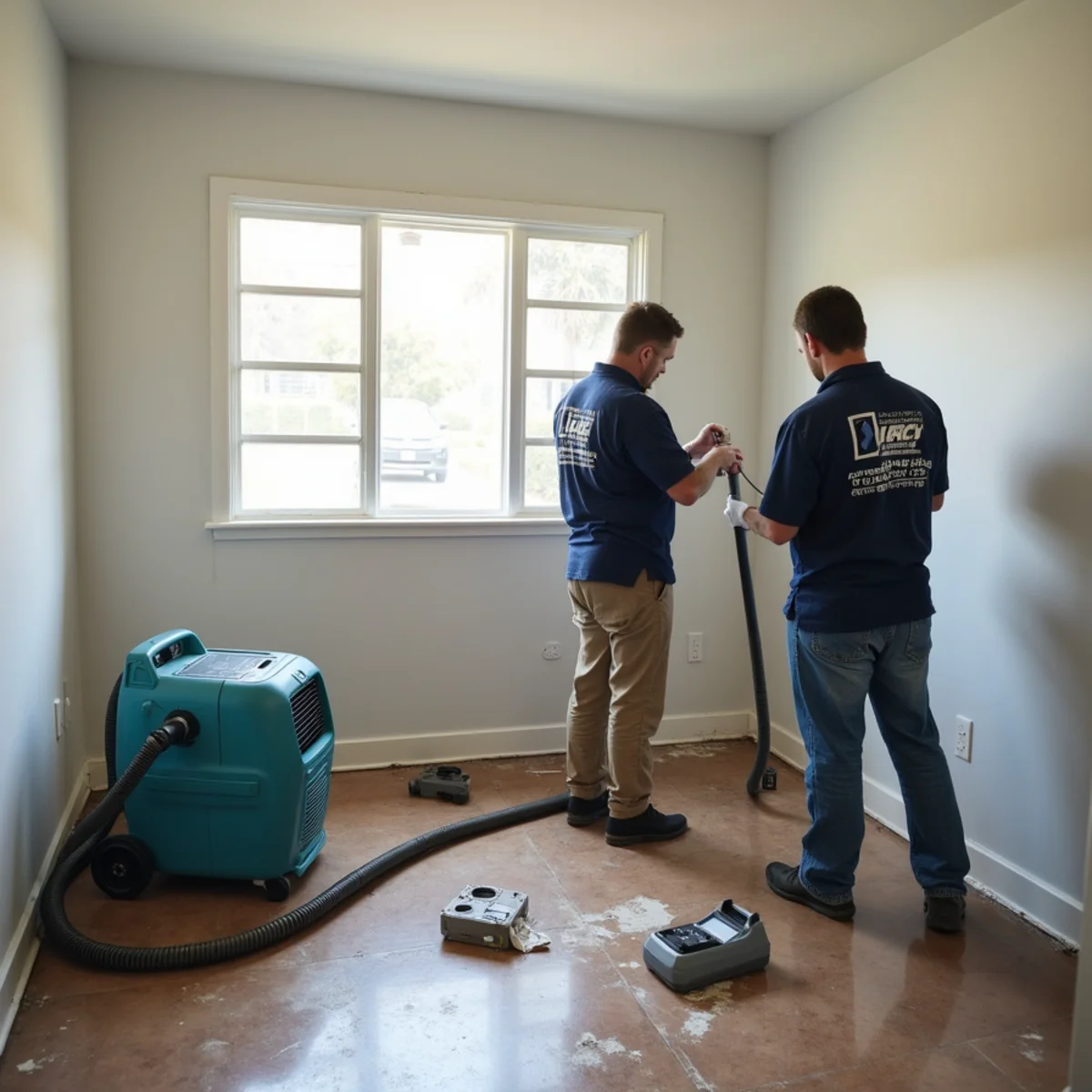
A technician returns every day, takes readings from the same mapped points, logs them, and adjusts equipment as materials release moisture.
Specialty drying where needed
Hardwood mat systems, cavity injection, cabinet venting and crawl-space units are added for assemblies that open-air drying can't reach.
Verify and demobilise
Equipment comes out when every mapped material meets the dry standard. You get the final readings and the full drying log.
- Documented dry standard
- Bonded & insured
- 24/7 emergency response
What it costs
What moves the price on a job like this
We won't quote your property over the phone — too many variables. Here's what an honest estimate is built from.
- 1
Days of active drying
Equipment is priced per unit per day. A three-day job and a seven-day job with the same footprint are very different invoices.
- 2
Affected volume, not just floor area
Vaulted ceilings and open floor plans mean more cubic feet of air to condition, which raises the dehumidification requirement.
- 3
Material mix
Carpet over slab dries fastest. Hardwood, plaster, tile over mud bed and dense cabinetry all need longer or need specialty systems.
- 4
Specialty equipment
Hardwood mat drying, desiccant dehumidification and injection systems cost more than standard refrigerant units — and often save a floor worth many times the difference.
- 5
Containment requirements
Sealing off a drying chamber in an occupied home or a live commercial space adds materials and setup labor.
The on-site assessment and written estimate are free. See our Rancho Cucamonga, CA cost guide for typical ranges.
Why RC Water Pros
Why Rancho Cucamonga homeowners call us for this
Five things we commit to on every job, before we ever pull into your driveway.
60-minute dispatch, from inside the city
Our crews and equipment stage off 11190 White Birch Dr in Rancho Cucamonga — not a regional hub an hour away. On structural drying that arrival gap is the difference between drying in place and demolition.
Every job run to the published S500 standard
Every job is run to the published industry standard for water damage restoration, with a documented dry standard established from your own unaffected materials — not a technician's judgement about what feels dry.
Adjuster-ready documentation on every job
Timestamped photos, moisture maps, daily drying logs, equipment run hours and a written scope, delivered in the format carriers expect. We speak to your adjuster directly so you aren't the middleman.
Extraction through rebuild, one contract
We don't dry your property and hand you a list of subcontractors. The crew that dries it puts the drywall, texture, paint, baseboard and flooring back, under one point of contact.
Free assessment and a written estimate
Free on-site assessment and written estimate, no charge to come and look, and a straight answer about whether the job is small enough for you to handle yourself.
FAQ
Structural Drying questions
How long does structural drying take?
Most residential jobs take three to five days of active drying. Deep saturation into hardwood, concrete or a crawl space can run a week or more. You'll see the daily readings, so you'll know where you are rather than waiting to be told it's finished.
Can't I just rent a dehumidifier and run my own fans?
You can, and for a very small spill it may be enough. The problems are capacity and verification: a consumer dehumidifier removes a fraction of what a commercial unit does, household fans provide no dehumidification at all, and without meters you have no way to know whether the wall cavity is actually dry. Running the HVAC to dry a house also spreads moisture and spores into rooms that were never affected.
Is the equipment loud, and can I stay in the house?
Yes, it's loud — air movers run continuously and you'll notice it. Most families stay, closing off the drying chamber and sleeping in unaffected rooms. We can adjust equipment placement around sleeping areas where the drying plan allows it.
Will running all that equipment spike my power bill?
It adds meaningfully to a few days of usage, and that's a legitimate question to ask up front. On insured losses, the increase is frequently reimbursable — keep the bill and we'll include the equipment run-hours in your documentation package.
How do you know when the drying is actually finished?
By comparing readings, not by touch. On day one we meter unaffected materials of the same type elsewhere in your house to establish the dry standard for this specific structure — framing, drywall and concrete each have their own. Then every affected material is read daily at the same mapped points until it reaches that target on consecutive readings. Equipment leaves when the numbers say so, and you get the final readings and the full drying log.
Can we turn the equipment off at night so we can sleep?
We would rather you did not, and it is worth understanding why. Drying is cumulative and the overnight hours are unsupervised, uninterrupted running time — switching off for eight hours a night can add days to the job and lets moisture redistribute in between. Where the noise is genuinely unliveable, tell us and we will look at repositioning equipment, adding containment, or a quieter configuration for that room rather than losing the hours.
Related services
- Water ExtractionTruck-mounted units pull standing and sub-surface water out in hours — the step that decides whether your floors survive.
- Mold RemediationContainment, HEPA filtration, source removal and moisture correction — remediation that fixes the cause, not just the stain.
- Water Damage RestorationEmergency extraction, structural drying and full rebuild — one crew from the first phone call to the final walkthrough.
Further reading
How Restoration Works
How Long Does Structural Drying Take? A Room-by-Room Timeline
Three to five days is typical — but the material, not the calendar, decides. Here's what drives the schedule.
5 min read
How Restoration Works
Why Your House Still Smells Musty After the Water "Dried"
The smell is microbial, not psychological. Here are the five places moisture hides after an incomplete dry-out.
5 min read
Where we work
Structural Drying across the Inland Empire
Based in Rancho Cucamonga, serving the surrounding cities and neighborhoods 24/7.
Need structural drying in Rancho Cucamonga?
Free assessment, 60-minute dispatch, and a real person on the phone at any hour.
- Documented dry standard
- Bonded & insured
- 24/7 emergency response