
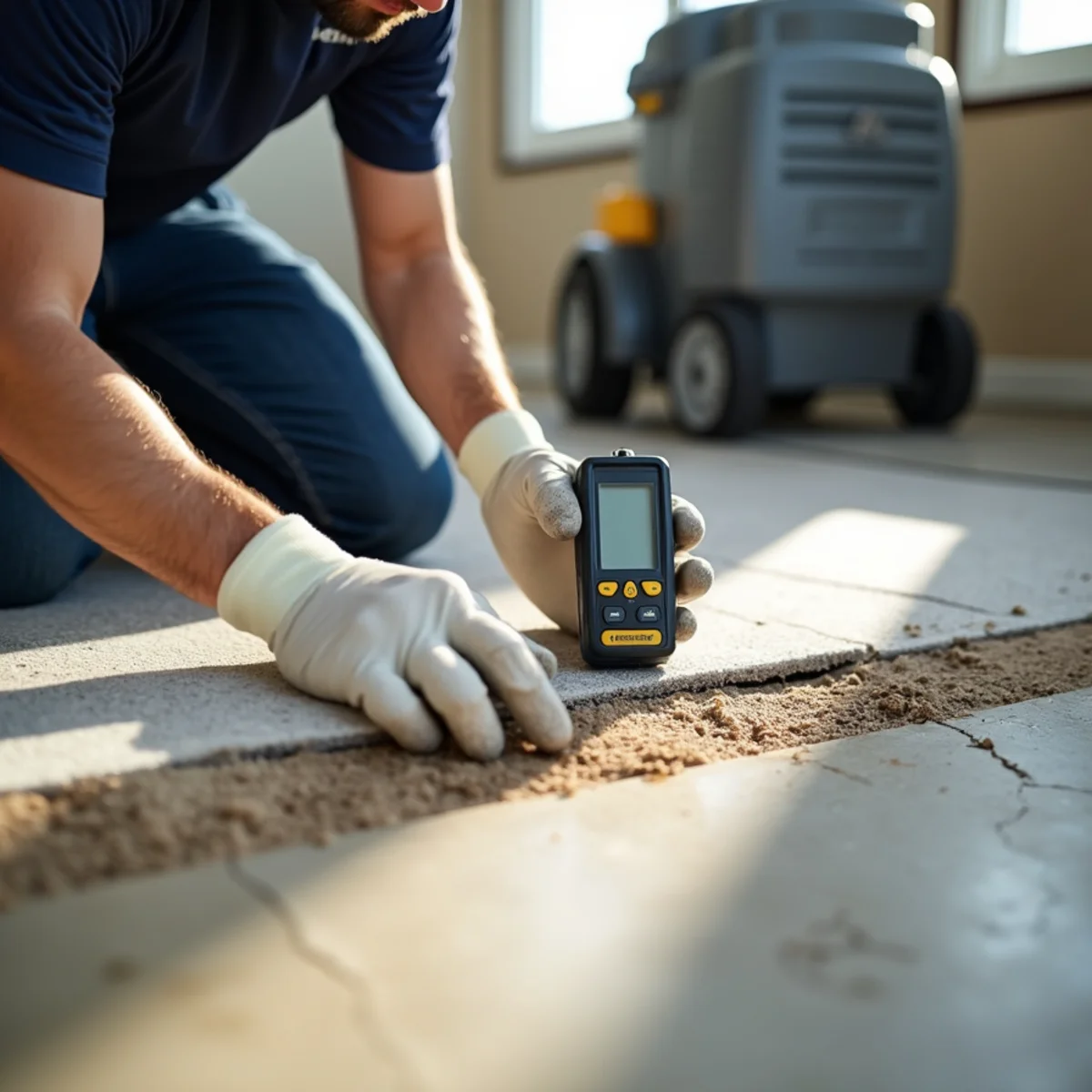
Free Written Estimate
Slab Leak Water Damage Restoration in Rancho Cucamonga, CA
The most common serious leak in Rancho Cucamonga's 1980s–90s tract homes. Detection, drying and full restoration.
- Documented dry standard
- Bonded & insured
- 24/7 emergency response
If you own a Rancho Cucamonga home built between roughly 1975 and 1999, there is a good chance your water lines run through or under a concrete slab — and that they're now old enough to start failing.
A slab leak is quiet, expensive, and often runs for weeks before anyone notices. We find it, handle everything the water damaged, and coordinate the repair. Call +1 (201) 277-9344.
Water actively spreading? Call now — every hour widens the damage and the bill.
+1 (201) 277-9344Do you need this service?
The six signs of a slab leak
Two of these together is enough to justify having it looked at.
A warm spot on the floor
The single most reliable indicator. A hot-water line leaking under the slab heats the concrete above it — usually noticed barefoot in a hallway or bedroom.
Your water bill jumped for no reason
A pinhole under a slab runs continuously, 24 hours a day. Bills often double before anything appears on the floor.
You can hear water running with everything off
Shut off every fixture and stand still in a quiet house. A faint continuous hiss or trickle means pressurised water is escaping.
Damp carpet or flooring with no source above it
Water works its way up through slab penetrations and cracks. A perpetually damp patch in the middle of a room is a classic presentation.
Cracking in flooring or new cracks in the slab
Sustained water under a slab softens the soil beneath it, which can lead to movement — and in expansive soils, to shifting.
A musty smell, especially in carpeted rooms
Carpet pad over a wet slab is one of the best mold-growing environments in a house. The smell often arrives before the wet spot does.
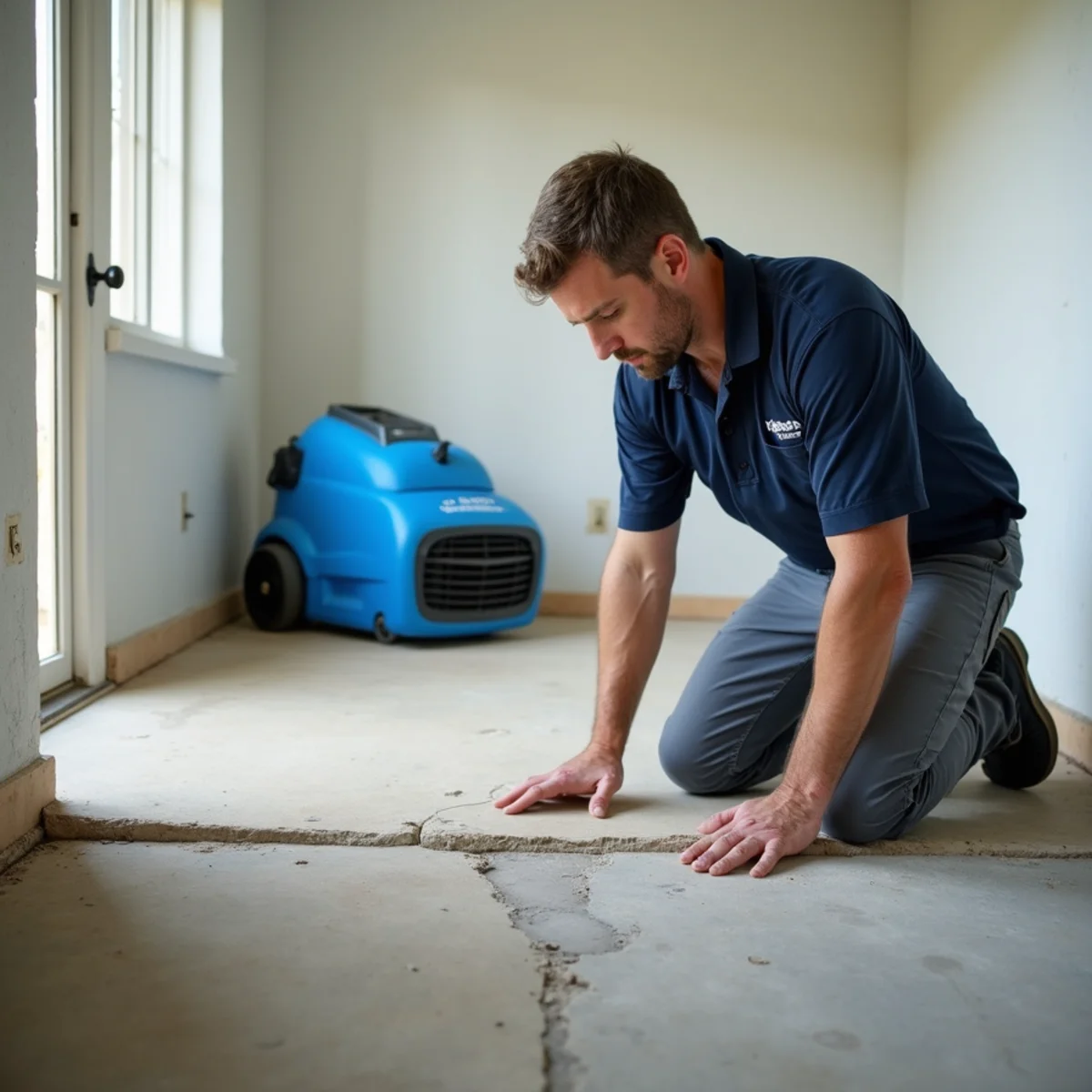
Why Rancho Cucamonga is slab leak country
This isn't a generic service page. The city's housing stock produces this specific problem at an unusual rate, and the reason is documented in the build history.
Roughly two-thirds of Rancho Cucamonga's owner-occupied homes were built between 1980 and 1999. The dominant construction method for that era in this region was slab-on-grade with copper supply lines routed through or beneath the concrete. Which means the median RC tract home now has copper in its slab that is 30 to 45 years old.
Then there's the water. The Inland Empire has hard water with a mineral profile that is unkind to copper. Over decades, the interior of the pipe pits — small, localised corrosion cells that eventually breach the wall from the inside out. That's a pinhole leak, and once one appears on a run, others typically follow within a few years, because the entire run has been exposed to identical conditions for identical time.
Add soil movement. Parts of the region, notably south Fontana, sit on expansive clay-loam soils that swell and shrink with moisture. That movement stresses everything buried in or below the slab.
The neighborhoods where we see the most of this are the dense slab-era tracts: Rochester, Terra Vista, Windrows, Vintage Park, Hermosa Park and much of Alta Loma.
Detection first, demolition never
We locate a slab leak before anything gets opened. Acoustic listening equipment traces the sound of escaping pressurised water through the concrete to a point. Thermal imaging maps the heat signature of a hot-side leak across the floor. Pressure isolation confirms whether the failure is on the hot line, the cold line or elsewhere entirely. Full detail on leak detection.
What that gets you is a pinpoint instead of an excavation. The difference between "somewhere under the west half of the house" and "here, at this point" is measured in thousands of dollars of flooring.
Repair options — and the honest trade-offs
The repair itself is a licensed plumber's work; we coordinate it and handle everything around it. There are three realistic paths, and it's worth understanding them before someone quotes you one.
Spot repair. Open the slab at the located point, cut out the failed section, repair, patch the concrete. Cheapest per incident. Correct when the system is otherwise sound and this is a genuine one-off. Involves opening your floor.
Reroute. Abandon the failed line in the slab and run a new line overhead through the attic and down walls. No slab excavation. Usually the right answer for a single failure on an otherwise-serviceable system, and it takes that line out of the slab permanently.
Whole-house repipe. Replace the supply system entirely, typically routed overhead. The most expensive option, and the correct one when you've had multiple pinholes — because the third leak on 40-year-old copper is not bad luck, it's the beginning of a pattern.
Here's the part nobody enjoys hearing: insurance typically covers the water damage and the cost of accessing the leak, but not the repipe. Carriers treat pipe replacement as maintenance. Budget accordingly, and read slab leak repair vs. repipe costs before you decide.
What we handle: everything the water touched
Once the leak is stopped, the restoration is ours.
Carpet and pad over a wet slab come up — pad almost always, carpet often salvageable if we're early. The slab itself gets dried, which is slower than drying framing because concrete releases moisture reluctantly, and it's the step most commonly cut short. Wall bases that wicked moisture get released and dried from behind. Baseboards and the lower drywall come out where they've been wet long enough. If growth has started under the flooring, it becomes a mold remediation scope with containment first.
Then flooring, baseboard, drywall and paint go back.
Post-tension slabs, and why they change the repair decision
Not every concrete slab can simply be opened where the leak is, and this is the detail that most often changes the plan on a newer home.
A post-tension slab contains steel tendons running through it under very high tension, tightened after the concrete cured. They are what gives the slab its strength, and they are entirely invisible from above. Cutting one is dangerous during the work and structurally significant afterwards, and repairing a severed tendon is a specialist job costing far more than the plumbing repair that caused it.
Construction of this type became common in parts of California from around the 1980s onward, particularly on expansive soils, so a proportion of the housing across this region has it. The usual clues are a warning plate at the garage or in a utility area stating that the slab is post-tensioned, and documentation in the original purchase paperwork — but plenty of homeowners have no idea either way.
What it changes. Before any concrete is opened, the slab is scanned to locate the tendons so the cut can be placed between them, and where that is not possible a structural engineer becomes part of the decision. It adds a step and a cost to a spot repair.
Why it often points to a reroute. An overhead reroute abandons the failed line and runs new pipe through the attic and down inside walls, so the slab is never opened at all. On a post-tension slab that avoids the scanning, the engineering question and the risk in one move — which is why, on these houses, the reroute is frequently the better answer even when a spot repair would have been cheaper elsewhere.
Our process
How slab leak damage works, step by step
Confirm and locate
Meter test, pressure isolation, acoustic listening and thermal imaging pinpoint the failure without opening the floor.
Map the water damage
Moisture readings across flooring, slab and wall bases establish how far the water has already travelled.
Coordinate the plumbing repair
We line up a licensed plumber and walk through spot repair, reroute or repipe with you — including what insurance will and won't pay for.
Remove and extract
Affected flooring and carpet pad come up, standing and absorbed water is extracted from the slab surface.
Dry the slab and wall bases
Concrete gives up moisture slowly. Equipment stays and readings continue until the slab itself — not just the surface — hits its dry standard.
Restore
Flooring, baseboard, drywall, texture and paint are replaced, with mold remediation first if growth was found underneath.
- Documented dry standard
- Bonded & insured
- 24/7 emergency response
What it costs
What moves the price on a job like this
We won't quote your property over the phone — too many variables. Here's what an honest estimate is built from.
- 1
How long the leak ran
Slab leaks are quiet, so they often run for weeks. Duration drives how far moisture spread through flooring and wall bases.
- 2
Flooring type
Carpet and pad are the cheapest outcome. Glued-down vinyl, tile over a mud bed, and engineered wood over slab often can't be lifted and reused.
- 3
Repair path chosen
Spot repair, overhead reroute and full repipe differ by an order of magnitude — and the repipe is generally not insured.
- 4
Slab drying time
Concrete releases moisture slowly, so slab drying runs longer than a comparable framing dry-out. That's equipment days on the invoice.
- 5
Mold under the flooring
Wet carpet pad over a warm slab grows quickly. If growth is present, containment and remediation come before any rebuild.
The on-site assessment and written estimate are free. See our Rancho Cucamonga, CA cost guide for typical ranges.
Why RC Water Pros
Why Rancho Cucamonga homeowners call us for this
Five things we commit to on every job, before we ever pull into your driveway.
60-minute dispatch, from inside the city
Our crews and equipment stage off 11190 White Birch Dr in Rancho Cucamonga — not a regional hub an hour away. On slab leak damage that arrival gap is the difference between drying in place and demolition.
Every job run to the published S500 standard
Every job is run to the published industry standard for water damage restoration, with a documented dry standard established from your own unaffected materials — not a technician's judgement about what feels dry.
Adjuster-ready documentation on every job
Timestamped photos, moisture maps, daily drying logs, equipment run hours and a written scope, delivered in the format carriers expect. We speak to your adjuster directly so you aren't the middleman.
Extraction through rebuild, one contract
We don't dry your property and hand you a list of subcontractors. The crew that dries it puts the drywall, texture, paint, baseboard and flooring back, under one point of contact.
Free assessment and a written estimate
Free on-site assessment and written estimate, no charge to come and look, and a straight answer about whether the job is small enough for you to handle yourself.
FAQ
Slab Leak Damage questions
How do I know if it's a slab leak and not something else?
The strongest combination is a warm floor spot plus a jump in your water bill plus a meter that keeps turning with every fixture closed. Any two of those together is worth a detection visit. A leak in a wall usually shows staining; a slab leak often shows nothing at all until flooring is affected.
Do you have to jackhammer my floor?
Not necessarily. Detection is non-invasive. If the repair path chosen is an overhead reroute — abandoning the line in the slab and running new pipe through the attic — the concrete is never opened. Spot repair does require opening the slab at one located point, which is why accurate detection matters so much.
Will insurance cover a slab leak?
Most California policies cover the resulting water damage and the cost of accessing the leak (tear-out and patch-back), but exclude repairing or replacing the pipe itself. Repipes are treated as maintenance and are generally not covered. Coverage also depends on the leak being sudden rather than a known long-term problem, which is why prompt reporting matters.
I've had one slab leak. Will I get more?
Statistically, it's likely. Pinhole corrosion is a whole-system condition, not a single defect — every foot of that copper has been in the same water for the same number of years. One leak is a repair; two within a couple of years is a strong signal to price a repipe rather than keep opening the floor.
How long does the slab take to dry?
Longer than drywall — concrete holds and releases moisture slowly. Expect several days minimum, sometimes longer for a large affected area, with readings taken from the slab itself rather than the air. Pulling equipment early here is the most common cause of mold under new flooring.
How do we know whether our slab is post-tensioned?
Look for a warning plate — typically at the garage, near the electrical panel or in a utility space — stating that the slab is post-tensioned and must not be cut or drilled without scanning. Your original purchase documents or the builder may confirm it. Where there is no plate and no paperwork, the slab is scanned before anything is opened. It is a short step and it is not optional: cutting a tendon is dangerous at the time and expensive afterwards.
Related services
- Leak DetectionThermal imaging, acoustic listening and moisture meters find the leak before we open anything up.
- Structural DryingAir movers and commercial dehumidifiers placed to a calculated load, with daily moisture readings you get to see.
- Mold RemediationContainment, HEPA filtration, source removal and moisture correction — remediation that fixes the cause, not just the stain.
Further reading

Local Risk & Rancho Cucamonga
Why Rancho Cucamonga's 1970s–90s Slab-on-Grade Tract Homes Are Slab-Leak Hotspots
One build era, one construction method, one water supply — and 40 years later, an entirely predictable wave of failures.
5 min read

Cost & Insurance
Slab Leak Repair vs. Whole-House Repipe: What Each Costs and What Insurance Covers
Three repair paths with very different price tags — and the uncomfortable fact that the one insurance won't pay for is often the right choice.
5 min read
Where we work
Slab Leak Damage across the Inland Empire
Based in Rancho Cucamonga, serving the surrounding cities and neighborhoods 24/7.
Need slab leak damage in Rancho Cucamonga?
Free assessment, 60-minute dispatch, and a real person on the phone at any hour.
- Documented dry standard
- Bonded & insured
- 24/7 emergency response