
Emergency Guides
Dishwasher Leaked Overnight and Flooded the Kitchen — Now What?
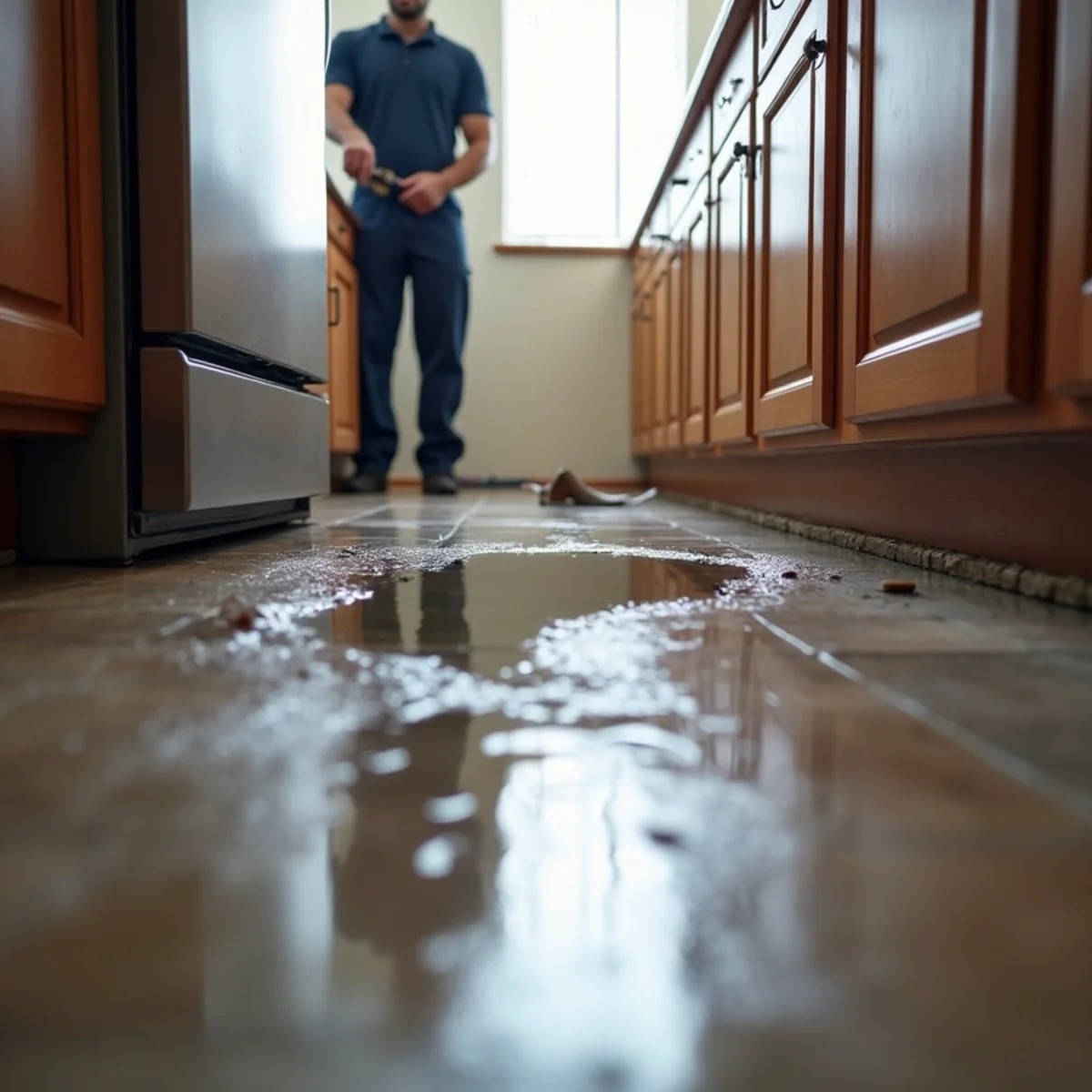
Dealing with this right now? We answer 24/7 and dispatch across Rancho Cucamonga in 60 minutes.
+1 (201) 277-9344Dishwasher leaks are deceptive. The puddle in front of the machine is usually the smallest part of the problem, because most of the water went sideways and underneath where you can't see it.
Here's how to handle it and, more importantly, how to find out what actually got wet.
| Where the water went | Can you see it? | Usual outcome |
|---|---|---|
| Across the kitchen floor | Yes | Extracts and dries, usually fine |
| Under the cabinet toe-kicks | No | Kick removed and dried; particleboard bases often lost |
| Under the flooring | No | Depends on the material — laminate and engineered rarely survive |
| Into the joist cavity below | No | Cavity opened and dried directly, or it comes back |
First: stop it
Shut off the dishwasher's water supply. The valve is usually under the kitchen sink — a small angle stop on the line running toward the dishwasher. If you can't identify it, close both angle stops under the sink, or use your main shut-off.
Cut power to the unit at the breaker. Don't just switch it off at the front panel — a leaking dishwasher with water around its base and live wiring underneath is worth isolating properly.
Don't run it again to test it. Whatever failed will fail again, with more water.
Then: find where the water actually went
This is the part that determines whether you have a mop-up or a restoration job.
Kitchens are the worst room in the house for hidden water, because they're full of enclosed cavities that absorb it and hide it.
Under the cabinets
Cabinet toe-kicks — the recessed base under the cabinet doors — form a shallow void that water runs straight into. It sits there, out of sight, against a floor made of particle board.
Particle board and MDF are the worst material in your house for water. They swell, delaminate and never recover. And the cabinet base under your sink is almost always one of them.
Open the cabinets. Feel the floor of each one, especially the sink base. Feel the back corners.
Under the flooring
Floating laminate or vinyl plank: water gets under the planks through the seams and sits on the subfloor. The surface can look completely dry while the underside is soaked. Swelling at the seams and edges that lift are the tell — and they can take days to appear.
Tile: the tile is fine. What's underneath may not be, particularly if it's over a wood subfloor rather than slab.
Sheet vinyl: water gets under at the edges and stays there indefinitely because it has nowhere to evaporate.
Behind and under the dishwasher
The unit sits in a recess with a cavity behind it. Water pools back there and wets the wall base. If your dishwasher is on an exterior wall or shares a wall with another room, check the other side.
The adjoining rooms
Kitchens open onto dining rooms, hallways, family rooms. Carpet at the transition wicks water several feet in under the surface with nothing visible on top. Press a flat hand on the carpet three or four feet out. Cool and damp means it's travelled.
Downstairs, if it's an upstairs kitchen
Rare, but check the ceiling below any second-floor plumbing.
Document before you clean
Photograph the failed component, the water line, the whole kitchen, and every affected item. Keep the failed part — a photograph of a split supply line or a cracked hose is what tells an adjuster this was sudden rather than a slow drip that ran for months.
What can be saved
Usually saved: solid wood cabinet frames and doors, tile, sealed hard surfaces, appliances that weren't submerged, granite and quartz countertops.
Usually not: particle board or MDF cabinet bases that were soaked, swollen laminate flooring, sheet vinyl with water underneath, and carpet pad in adjoining rooms.
Depends entirely on speed: engineered wood flooring, hardwood, plywood subfloor, and cabinet boxes that got damp rather than soaked. These are the ones where calling on day one instead of day four genuinely changes the outcome.
Why the 24–48 hour window matters here specifically
Kitchens are warm, they're enclosed, and cabinet cavities have essentially no airflow. That's close to ideal for microbial growth, and the clock to visible mold in wet materials is roughly 24 to 48 hours.
The cabinet under your sink is the classic case: dark, unventilated, particle board base, and now wet. If it isn't opened and dried within that window, you're looking at mold remediation rather than drying.
This is why professionals open and vent cabinet toe-kicks rather than pointing a fan at the kitchen floor. The water isn't on the floor. It's underneath the cabinet you can't see into.
What restoration actually does here
Extraction of surface water and anything trapped under flooring. Removal of the toe-kick panels so air can reach the cavity underneath. Drilling and venting cabinet bases where needed. Lifting floating floor sections to release trapped water rather than trying to dry through them.
Then structural drying with meters reading the actual cabinet material and subfloor — not the room air — until they hit a documented dry standard.
Then rebuild of whatever came out.
The slow-leak version, which is worse
Everything above assumes a sudden failure. The more expensive version is the dishwasher that has been leaking a small amount for months.
The signs: a musty smell in the kitchen with no obvious source, a cabinet base that's soft or discoloured, flooring that lifts or cups near the dishwasher, and a toe-kick that shows staining.
That version is almost always a mold job by the time it's found, and it's also the version insurance is most likely to contest — gradual damage from a slow leak is typically excluded, while sudden discharge is covered.
Which is a good argument for pulling the toe-kick and looking underneath once a year, particularly in newer homes across Ontario Ranch and around Victoria Gardens where appliance connections are the dominant failure mode.
If the kitchen is on a second floor
An upstairs kitchen turns a contained appliance failure into a multi-level loss, and it is worth understanding why the damage is disproportionate.
Water leaving a dishwasher spreads across the floor, finds the nearest gap in the flooring — usually at the edge of the cabinet run or a threshold — and drops into the joist cavity. From there it does two things at once: it saturates the underside of the subfloor and the joists themselves, and it runs along the framing until it finds a wall to travel down.
The result is that the visible damage downstairs frequently appears in a different room from the kitchen above it. A stain in a hallway ceiling, or damp at the base of a wall six feet from where anyone would expect it.
That is why an upstairs kitchen loss needs the cavity opened and metered rather than dried from the rooms on either side. Three assemblies are wet, only two of them are visible, and the invisible one decides whether the repair holds.
Prevention
Replace the braided supply line if it's original. Check under the sink and under the toe-kick once a year. Put a leak sensor under the dishwasher and under the sink — they cost very little and they catch the slow version before it becomes a remediation.
Kitchen flooded now? Call +1 (201) 277-9344.
FAQ
Questions people also ask
How do I know if water got under my cabinets?
Open every cabinet near the dishwasher and feel the floor of each one, especially the sink base and the back corners. Then look at the toe-kick — the recessed panel under the cabinet doors. Water runs straight into that void and sits there against particle board. If the toe-kick is stained or the cabinet floor feels soft, water is underneath.
Can laminate flooring be saved after a dishwasher leak?
Sometimes, if we get under it quickly. Water reaches the subfloor through the seams and sits there while the surface looks dry, so the fix is lifting sections to release the trapped water rather than trying to dry through the planks. Once the planks have swollen at the seams, they're generally a replacement.
My dishwasher has been leaking slowly for months. Is that covered by insurance?
Usually not. California policies generally cover sudden and accidental discharge while excluding gradual damage from a long-term leak. That's exactly why it's worth pulling the toe-kick panel and checking underneath once a year — a slow leak found early is a repair, and found late it's a mold remediation you pay for yourself.
Do the cabinets have to come out?
The boxes usually stay; the toe-kicks and any particleboard bases frequently do not. We remove the kick to open and dry underneath, which is where the water actually goes, and assess the base material from there. Solid wood and plywood construction dries well. Particleboard that has swollen has lost its structure permanently and will not recover, whatever it looks like once the surface dries.
Services mentioned
- Water ExtractionTruck-mounted units pull standing and sub-surface water out in hours — the step that decides whether your floors survive.
- Structural DryingAir movers and commercial dehumidifiers placed to a calculated load, with daily moisture readings you get to see.
- Mold RemediationContainment, HEPA filtration, source removal and moisture correction — remediation that fixes the cause, not just the stain.
Keep reading
Emergency Guides
Standing Water in the House: Is It Safe to Stay, and Who Do You Call First?
Three questions decide it: is the electricity safe, what's in the water, and is the structure sound. Work through them in order.
5 min read

Emergency Guides
How to Find and Shut Off Your Home's Main Water Valve (Before You Ever Need To)
Do this on a Saturday afternoon in daylight, not at 2 a.m. in the dark with water rising. Here's exactly where to look.
4 min read
Emergency Guides
Washing Machine Supply Line Burst: 5 Steps to Limit the Damage
Shut it down, find where the water actually went, and understand why this failure so often happens when nobody is home.
5 min read