
Local Risk & Rancho Cucamonga
Inland Empire Hard Water Is Eating Your Copper Pipes: What RC Homeowners Can Do About Pinhole Leaks
Dealing with this right now? We answer 24/7 and dispatch across Rancho Cucamonga in 60 minutes.
+1 (201) 277-9344Copper is a good plumbing material. It lasts decades, it handles pressure and heat, and it doesn't off-gas anything.
What it doesn't handle indefinitely is aggressive water — and Inland Empire water is aggressive.
What a pinhole leak is not, since the name misleads people:
- Not a burst. It weeps rather than sprays, often for weeks before anything shows.
- Not sudden. The corrosion took decades; only the discovery is sudden.
- Not a one-off. The rest of the system is the same age, in the same water.
- Not solved by the patch. A repair fixes the hole that announced itself, nothing else.
What pinhole corrosion actually is
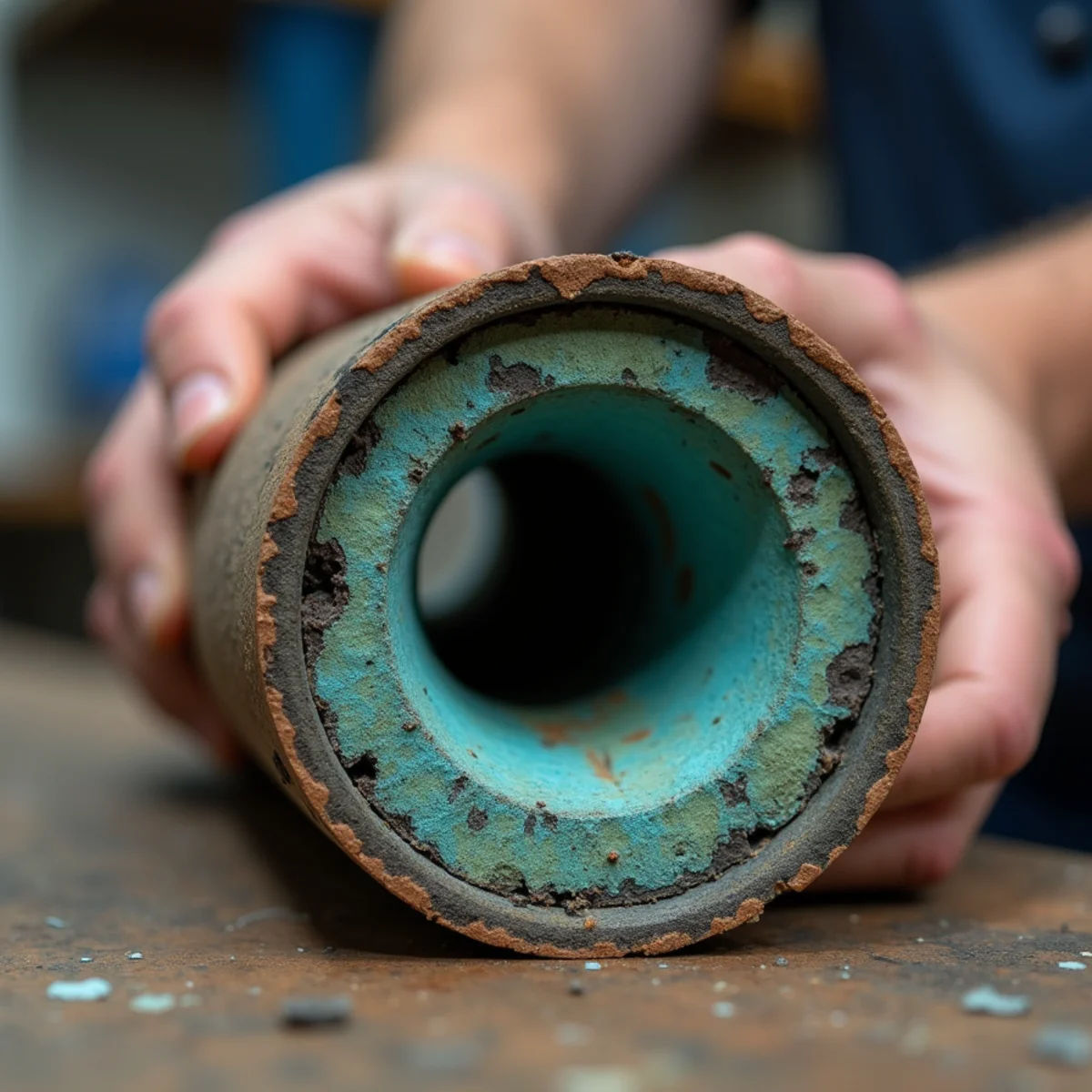
It isn't general rusting. Copper doesn't rust; it develops a protective oxide layer on its inner surface that normally shields the metal underneath.
Pinhole corrosion happens when that protective layer breaks down in localised spots. At each spot, a tiny electrochemical cell forms: the metal there becomes anodic relative to the surrounding pipe wall and starts dissolving. The attack is concentrated on a very small area, so it drills rather than thins.
Eventually it drills all the way through. That's the pinhole — a breach through a pipe wall that's otherwise in reasonable condition.
The critical implication: the failure isn't the result of the pipe being worn out overall. It's the result of conditions that produce localised attack, and those conditions exist along the entire length of that pipe. Which is why one pinhole reliably predicts more.
Why here
Several factors combine in this region.
Mineral hardness. High dissolved mineral content, which precipitates as scale and creates the surface irregularities where localised cells form.
Water chemistry. Disinfectant residual, pH and dissolved oxygen all influence how stable that protective oxide layer is. Water treated with chloramine — common across the region — behaves differently toward copper than water treated with free chlorine.
Water velocity. High flow rates and sharp turns cause erosion corrosion, physically scouring the protective layer. Undersized pipe and high system pressure both make this worse.
Temperature. Hot water lines fail first, consistently. Higher temperature accelerates every reaction involved — which is why the classic slab leak here is a hot-side leak producing a warm floor.
Time. Forty years of any of the above.
The scale problem, separately
Hard water also causes scale buildup, which is a different problem with its own consequences:
Inside your water heater, sediment settles on the tank bottom, insulates it from the burner, forces longer run times, and accelerates consumption of the sacrificial anode rod — the component that corrodes so your tank doesn't. Once the anode is gone, the tank starts corroding. This is a large part of why water heaters here often fall short of their nominal 8–12 year life.
In fixtures and valves, scale seizes angle stops and shower valves so they won't close when you finally need them to.
In appliances, it shortens the life of dishwashers, washing machines and icemakers.
What actually helps
A water softener removes hardness minerals. It genuinely helps scale, appliance life and water heater longevity. Its effect on pinhole corrosion is more complicated — softened water is not automatically less corrosive, and in some conditions can be more so. Treat softening as a scale and appliance measure rather than a guaranteed pipe-saving one.
A pressure regulator, correctly set. If your static pressure is high — above roughly 80 psi — you're accelerating erosion corrosion and stressing every fitting and appliance. Testing pressure is a five-dollar gauge and five minutes, and adjusting or replacing a failed regulator is a cheap plumber visit with a real payoff.
Annual water heater flushing removes accumulated sediment and extends tank life meaningfully in this water.
Anode rod inspection at around five years. A rod that's consumed can be replaced for a fraction of a new tank.
Whole-house filtration helps with sediment and some chemistry, but it isn't a corrosion cure.
When to stop patching
Here's the honest guidance.
First pinhole leak: repair it. It could be an isolated bad spot.
Second pinhole within a few years: price a repipe. Two failures on the same system is the pattern asserting itself, and every subsequent repair is money spent on a countdown.
Declining pressure across the whole house, or visible green-blue staining at fittings, or discoloured water: get the system assessed regardless of leak history.
A repipe is expensive, and insurance won't pay for it — carriers treat it as a maintenance upgrade rather than damage repair. But three more emergency calls, each with flooring damage and drying costs, is expensive too, and considerably more disruptive.
Where we see it most
The 1980s–90s slab-era tracts across Rancho Cucamonga — Vintage Park, Rochester, Terra Vista, Windrows — where in-slab copper is at 35–45 years.
The 1960s–80s housing across Upland, La Verne and Montclair, which is further along.
And in the genuinely old stock — pre-1960 Upland, Ontario and Pomona — it's a different metal with the same story: original galvanized steel corroding internally for seventy-plus years, producing falling pressure first and pinholes second.
The pressure factor
Water chemistry gets the attention, but pressure is the other half of the equation and it is much cheaper to fix.
Copper fails where turbulence and pressure meet corrosion. High static pressure accelerates pinhole development, drives water through a marginal fitting that would otherwise have held, and turns a small failure into a fast one. It also shortens the life of every flexible connector, angle stop and appliance valve in the house — the components that cause most sudden floods.
Municipal supply pressure varies with elevation, and homes on the lower end of a distribution zone can sit noticeably higher than those above them. Anything much above the region's typical residential range is worth addressing.
The check is simple: a threaded gauge on a hose bib costs very little and reads in seconds. If the number is high, a pressure regulator at the service entry is an ordinary plumbing job.
Two things worth knowing. Regulators fail — usually by drifting upward — so an existing one is not a guarantee, and it is worth re-testing every couple of years. And a thermal expansion tank is normally required alongside one on a closed system, which is a detail some older installations are missing.
The practical checklist
Test your static water pressure. Flush your water heater annually. Have the anode rod checked around year five. Watch your water bill for unexplained jumps. And after a second pinhole, have the repipe conversation rather than the third repair conversation.
Leak now? +1 (201) 277-9344.
FAQ
Questions people also ask
Will a water softener stop pinhole leaks?
It'll help with scale, appliance life and water heater longevity, but it isn't a guaranteed fix for pinhole corrosion — softened water isn't automatically less corrosive to copper and in some conditions can be more so. Treat softening as a scale and appliance measure. Correct system pressure and annual water heater maintenance are the more reliable wins.
Why do hot water lines fail first?
Temperature accelerates every reaction involved in the corrosion process. That's why the classic Inland Empire slab leak is a hot-side failure producing a warm spot on the floor, and why hot lines generally reach their first pinhole well before the cold side does.
How many pinhole leaks before I should repipe?
Repair the first — it might be an isolated bad spot. After a second within a few years, price a repipe seriously. Pinhole corrosion is a whole-system condition rather than a point defect, so two failures means the rest of that copper is at a similar stage. Insurance won't cover the repipe, but neither will it cover repeated flooring damage.
Could high water pressure be making it worse?
Very likely, and it is much cheaper to fix than the chemistry. High static pressure accelerates pinhole development and shortens the life of every connector, angle stop and appliance valve in the house. A threaded gauge on a hose bib costs a few dollars and reads in seconds; if the number is high, a pressure regulator at the service entry is an ordinary plumbing job. Existing regulators drift upward as they age, so retest every couple of years.
Services mentioned
- Leak DetectionThermal imaging, acoustic listening and moisture meters find the leak before we open anything up.
- Burst Pipe CleanupA failed supply line can put hundreds of gallons into your house in an hour. We stop it, pull it out and dry it.
- Slab Leak DamageThe most common serious leak in Rancho Cucamonga's 1980s–90s tract homes. Detection, drying and full restoration.
Keep reading

Local Risk & Rancho Cucamonga
Spike in Your Cucamonga Valley Water District Bill? You Might Have a Hidden Leak
A slab leak runs 24 hours a day. Your bill notices long before your floor does — if you're reading it.
5 min read
Local Risk & Rancho Cucamonga
Do Pipes Really Freeze in Rancho Cucamonga? Foothill Freeze Nights in Alta Loma and Etiwanda
Interior plumbing is fine. Hose bibs, pool equipment and irrigation backflow are the ones that split at 3 a.m. in January.
5 min read
Local Risk & Rancho Cucamonga
South Fontana's Expansive Clay Soils: Why Slabs Crack, Walls Shift, and Pipes Shear
A slab leak wets the soil, the soil swells, the slab moves, the movement stresses the pipe. Here's how to break the loop.
5 min read