
Local Risk & Rancho Cucamonga
Do Pipes Really Freeze in Rancho Cucamonga? Foothill Freeze Nights in Alta Loma and Etiwanda
Dealing with this right now? We answer 24/7 and dispatch across Rancho Cucamonga in 60 minutes.
+1 (201) 277-9344The short answer: yes, occasionally, and not the pipes you'd think.
Rancho Cucamonga's record low temperatures sit in the mid-20s Fahrenheit, and while the valley floor rarely gets near that, the higher-elevation neighborhoods do — on clear, still winter nights when radiational cooling drops temperatures well below what the forecast for the city centre suggests.
| On a clear winter night | What is at risk |
|---|---|
| Around freezing | Uncovered hose bibs, especially with a hose still attached |
| A few degrees below | Irrigation backflow assemblies, pool and spa equipment plumbing |
| A sustained cold snap | Any supply line running through an unheated garage, attic or exterior wall |
| Any of the above | Nothing inside a heated wall — interior plumbing is not the problem here |
What actually freezes here
Not your interior plumbing. Pipes running inside heated walls in an occupied house are fine. This isn't Denver.
What does freeze:
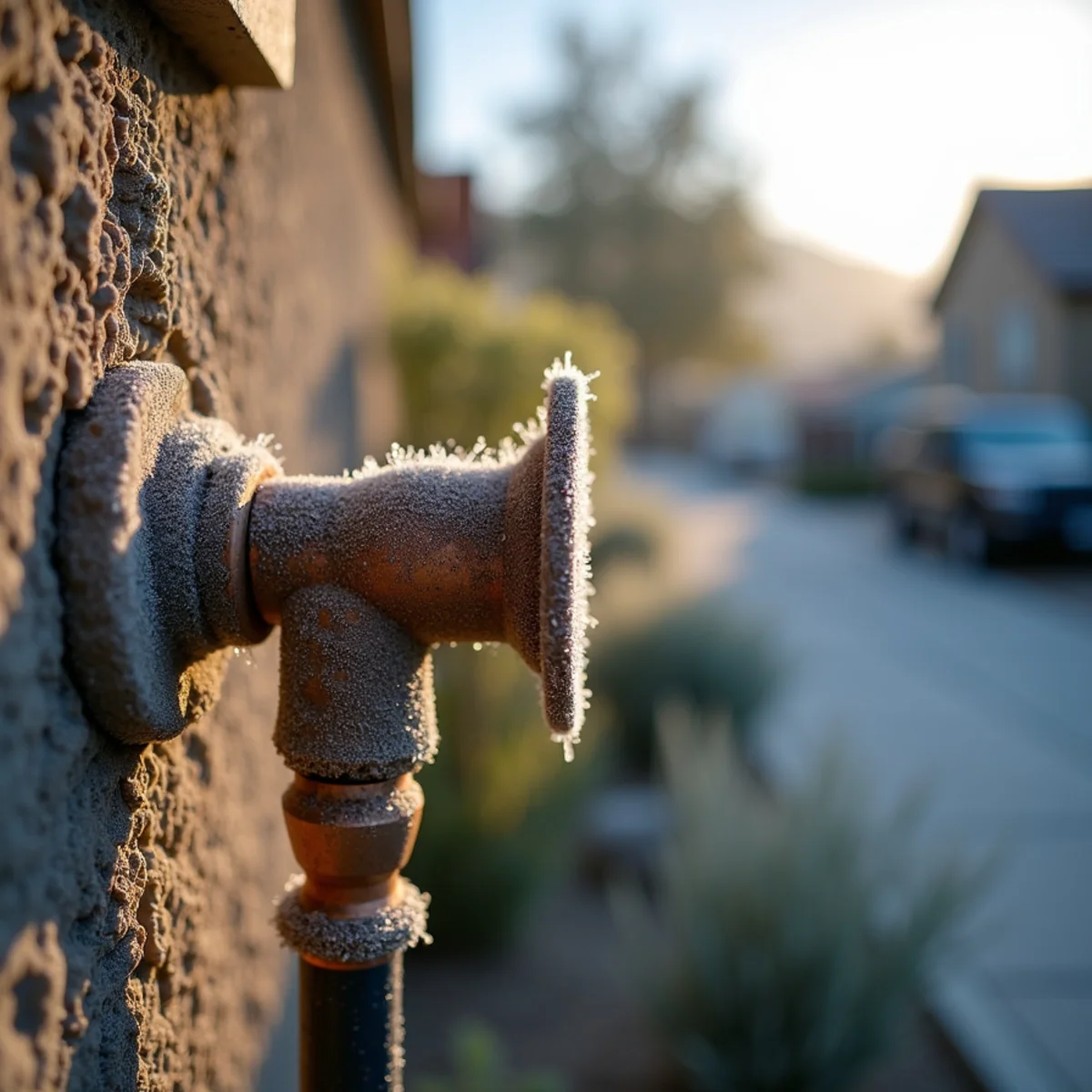
Hose bibs and exterior spigots. The single most common. The valve body and the short run of pipe behind it sit in unheated exterior wall. Water in that section freezes, expands, and splits either the bib or the pipe behind it. Often the split isn't discovered until spring when someone turns the tap on and water pours into the wall.
Irrigation backflow preventers. Above-ground assemblies with exposed brass bodies and internal chambers. They're cast metal and they crack.
Pool and spa equipment plumbing. Exposed PVC runs to and from pumps, filters and heaters, plus the pump housings themselves.
Pipes in unconditioned spaces. An unheated garage on a cold night, a crawl space with open vents, an attic run, or a line running through a detached structure.
Exterior lines to outbuildings. Barns, workshops and detached garages on larger properties — Alta Loma's big lots, San Antonio Heights, the equestrian parcels around San Dimas.
Why the foothills and not the valley
Cold air is dense and drains downhill, but the more relevant factor is radiational cooling on clear, calm nights. Without cloud cover or wind mixing, surfaces radiate heat to the sky and the air immediately above them cools sharply.
Higher-elevation neighborhoods — upper Alta Loma, Haven View Estates, Etiwanda above about 1,500 feet, Deer Creek, and further afield Grand Terrace's Blue Mountain slopes — reach temperatures the flat valley floor doesn't.
Etiwanda ranges up to around 2,500 feet at its highest. That's enough elevation to matter on the coldest handful of nights each winter.
Why a burst exterior line is worse than it sounds
A split hose bib at 3 a.m. is delivering water at full mains pressure, and nobody is awake to hear it.
By morning, that's several hundred gallons — and on a sloped foothill lot, it's all run downhill toward the house. We've extracted water from lower levels, garages and crawl spaces that came from a two-dollar failure on an exterior wall.
The wall behind the bib is also wet, and because the split is often only discovered in spring, that wall may have been wet for weeks.
The prevention, which is genuinely cheap
Foam hose bib covers. A few dollars each, fit in seconds. This is the highest-return item in this entire article. Buy them in October.
Disconnect garden hoses. A hose left attached traps water in the bib and prevents it draining, which is a large part of why bibs split.
Insulate the backflow preventer. An insulated cover or wrapped insulation on the exposed assembly.
Winterise pool and spa plumbing — or, if the equipment runs through winter, know how to protect it on a forecast cold night. Many systems have a freeze-protect mode that circulates water when temperature drops; moving water doesn't freeze as readily.
Insulate pipes in unconditioned spaces. Foam pipe sleeve is inexpensive and easy on accessible runs in a garage, attic or crawl space.
On a genuinely cold forecast night: leave one interior faucet dripping slightly if you have lines running through an unheated space, and open cabinet doors under sinks on exterior walls to let warm air in.
If a pipe does freeze
Don't use an open flame. Ever. It's the most common cause of house fires connected to frozen pipes.
Open the faucet served by the frozen line, so melting water has somewhere to go and pressure can't build.
Apply gentle heat — a hairdryer, a heat lamp, warm towels — starting at the faucet end and working back toward the frozen section. Never start in the middle; you'll trap expanding water between two ice plugs.
If it has already burst: shut off the main immediately, then the fixture. Then call.
What we see in practice
We take a handful of these calls each winter, and they cluster on the two or three coldest nights of the season. The profile is consistent: a foothill address, a split exterior bib or irrigation assembly, and several hours of unattended flow that ran downhill into the structure.
Every one of them would have been prevented by a foam cover and a disconnected hose.
The other version — discovered in April when someone turns the tap on for the first time since autumn — is worse, because that wall has been sitting wet with whatever grew in it.
Leaving the house empty in winter
The failures that do real damage up here almost all happen to houses with nobody in them. A line that splits while the family is home gets noticed in minutes; the same line at an empty house runs until somebody arrives.
If you are away for more than a couple of nights in winter, the short version is:
Shut the water off at the main. This single action makes every other precaution optional. There is no version of a plumbing failure that floods a house whose supply is closed.
Leave the heat on, low. Somewhere in the high fifties is enough to protect interior plumbing and it costs very little over a week.
Drain what is exposed. Disconnect hoses from the bibs — a connected hose holds water in the bib and is the most common single cause of a split — and put foam covers on.
Have somebody look in. A neighbour with a key who walks through once mid-trip will catch in a day what otherwise runs for a fortnight.
Fit sensors before you go. A sensor that alerts a phone is worth little if nobody can act on it, so pair it with someone local who can.
The October addendum
While you're clearing gutters and flushing yard drains for the rainy season, add three minutes: disconnect the hoses, fit the covers, and wrap the backflow preventer.
Burst pipe now? +1 (201) 277-9344, 24/7.
FAQ
Questions people also ask
Do I need to worry about frozen pipes in Southern California?
Interior plumbing in a heated house, no. Exposed exterior plumbing at foothill elevations, occasionally yes — the city's record lows are in the mid-20s and the higher neighborhoods reach freezing on clear, still winter nights. Hose bibs, irrigation backflow preventers and pool equipment are what actually split.
What's the cheapest freeze protection?
Foam hose bib covers — a few dollars each and seconds to fit — plus disconnecting garden hoses so water can drain out of the bib rather than sitting in it. Those two things prevent the overwhelming majority of the freeze calls we take.
How do I thaw a frozen pipe safely?
Open the faucet the line serves so melting water has somewhere to go, then apply gentle heat — hairdryer, heat lamp, warm towels — starting at the faucet end and working back. Never use an open flame, and never start heating in the middle of a frozen section, which traps expanding water between two ice plugs.
What should we do before leaving the house empty in winter?
Shut the water off at the main — that single action means no plumbing failure can flood the house while you are away. Leave the heat on low to protect interior pipework, disconnect every hose from its bib and fit foam covers, and have somebody local walk through once mid-trip. A sensor that alerts a phone is only worth having if someone nearby can act on it.
Services mentioned
- Burst Pipe CleanupA failed supply line can put hundreds of gallons into your house in an hour. We stop it, pull it out and dry it.
- Emergency Water RemovalOne number, answered by a person, any hour of any day — with a truck rolling before the call ends.
- Structural DryingAir movers and commercial dehumidifiers placed to a calculated load, with daily moisture readings you get to see.
Keep reading
Local Risk & Rancho Cucamonga
Spike in Your Cucamonga Valley Water District Bill? You Might Have a Hidden Leak
A slab leak runs 24 hours a day. Your bill notices long before your floor does — if you're reading it.
5 min read
Local Risk & Rancho Cucamonga
South Fontana's Expansive Clay Soils: Why Slabs Crack, Walls Shift, and Pipes Shear
A slab leak wets the soil, the soil swells, the slab moves, the movement stresses the pipe. Here's how to break the loop.
5 min read
Local Risk & Rancho Cucamonga
California's Water Heater Strapping Law (HSC §19211): The Earthquake Leak Risk Hiding in Your Garage
Strapping stops your tank falling over in a quake. It does nothing about the tank corroding — and people conflate the two.
5 min read