
Local Risk & Rancho Cucamonga
California's Water Heater Strapping Law (HSC §19211): The Earthquake Leak Risk Hiding in Your Garage
Dealing with this right now? We answer 24/7 and dispatch across Rancho Cucamonga in 60 minutes.
+1 (201) 277-9344California Health & Safety Code §19211 requires water heaters to be braced, anchored or strapped to resist falling or horizontal displacement during an earthquake.
It's a good law. It's also widely misunderstood in a way that costs homeowners money.
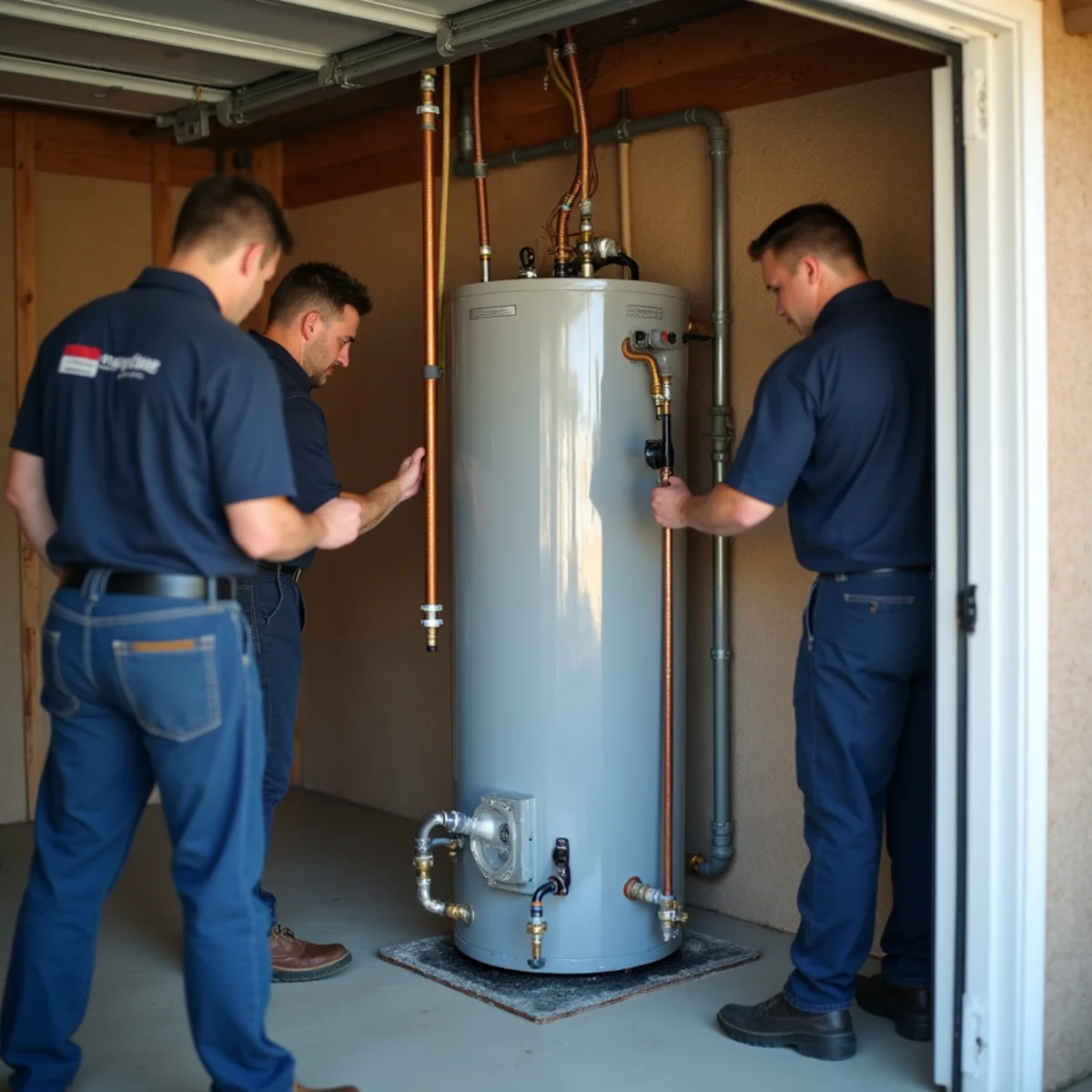
What a compliant, well-made installation generally looks like — confirm the specifics with your local building department, since jurisdictions vary:
- Two straps, one in the upper third of the tank and one in the lower third, kept clear of the controls.
- Anchored into structure — studs or masonry — not just into drywall.
- A drain pan piped to an actual discharge point, not a pan sitting on the floor.
- A relief valve discharge line run to a safe termination.
- Flexible connectors on the water lines, and on the gas line where gas is used.
What the law requires
The statute requires that water heaters be secured against seismic movement. The implementing standard, applied through the plumbing code and enforced by local jurisdictions, generally means:
Two straps — one in the upper third of the tank, one in the lower third, with the lower strap at least four inches above the controls on a gas unit.
Anchored into structure — into wall studs or masonry, not into drywall alone.
Flexible connectors on the water and gas lines, so limited movement doesn't shear a rigid connection.
Compliance is generally checked at point of sale, which is why it comes up during real estate transactions. Sellers are commonly required to certify compliance.
What it prevents
A full 50-gallon tank weighs several hundred pounds. In a quake, an unsecured one can walk, tip, or fall — shearing the water connections and, on a gas unit, the gas line.
That's the failure mode the law addresses: a toppled tank flooding a garage while a sheared gas line vents into the same space. It's a genuinely serious hazard and the strapping requirement is well founded.
What it does not prevent
Strapping does nothing about the tank corroding.
This is the conflation we run into constantly. A homeowner mentions that their heater was inspected and certified at sale, and treats that as evidence the unit is in good condition.
It isn't. Seismic compliance and tank condition are unrelated facts. A perfectly strapped, fully code-compliant water heater can be eight years into a corrosion process that ends with the seam letting go on a Tuesday afternoon.
What actually kills water heaters here
The failure mode we respond to is internal corrosion, and Inland Empire hard water accelerates it.
Sediment. Dissolved minerals precipitate and settle on the tank bottom. That layer insulates the steel from the burner below, so the burner runs longer and the steel above the sediment gets hotter than designed. It also makes the popping and rumbling sounds people notice during heating.
Anode rod consumption. Every tank contains a sacrificial anode rod, made of a metal that corrodes preferentially so the tank steel doesn't. Hard water consumes it faster. Once it's gone, the tank itself begins corroding — and from there it's a countdown.
Result: the nominal 8–12 year service life tends toward the short end here. We see plenty of tanks fail before ten.
The thing that's actually missing from most installations
Look at your water heater and answer one question: is there a drain pan under it, and is that pan piped to somewhere?
A pan with no drain line holds about a gallon. It's decorative.
A pan properly piped to a floor drain or to an exterior discharge point turns a catastrophic tank failure into a puddle outside. On a garage installation, that's a significant difference. On an interior closet installation — common in attached housing and some condominiums — it's the difference between a nuisance and a flooded finished floor.
If your tank is in an interior closet or an upstairs location and the pan isn't plumbed, that's worth fixing regardless of the tank's age.
The maintenance that actually extends life
Flush the tank annually. Drains the sediment layer off the bottom. Straightforward DIY or a cheap plumber visit, and it makes a real difference in this water.
Check the anode rod around year five. Replacing a consumed rod costs a fraction of a new tank and can add years.
Test the T&P valve occasionally — the temperature and pressure relief valve is the safety device that prevents the tank becoming a pressure vessel.
Watch the base for rust staining or a puddle that keeps reappearing. That's a tank telling you it's corroded through somewhere.
When to replace on schedule
Past ten years, replace it on your terms rather than its own.
The arithmetic is straightforward: a planned replacement is a scheduled cost. An unplanned one is a replacement plus a flooded garage, wet drywall, ruined stored belongings, drying equipment for several days, and possibly mold in a hot garage.
And insurance covers the second half of that but not the water heater itself — carriers treat the appliance as a maintenance item.
What we see
Water heater failures are among the most common calls we take, particularly in neighborhoods with long-tenure ownership where nothing forces component replacement — Los Osos, Heritage Village, Archibald Ranch in Ontario.
The pattern is consistent: a tank between twelve and twenty years old, in a garage, on a slab that drains toward the interior door. Forty to eighty gallons onto that slab heads for the hallway carpet.
See water heater leak cleanup for what the response involves.
If you have a tankless unit
Tankless water heaters change the risk profile rather than removing it, and the maintenance they need is different enough to be worth stating.
There is no eighty-gallon tank to fail catastrophically, which removes the single worst failure mode. What remains is a wall-mounted appliance with supply and return connections, an isolation valve kit, a condensate drain on condensing models, and — in this region — a heat exchanger that scales.
Scale is the main enemy. Hard water deposits inside the exchanger reduce efficiency, then cause error codes, then shorten the unit's life considerably. Descaling with a flush kit is an annual job here rather than the every-few-years suggestion the manual might imply, and the isolation valves that make it a thirty-minute task are worth having fitted if the original installer skipped them.
The connections still leak. Flexible connectors, the pressure relief line and the condensate drain all fail in the ordinary way, and because the unit is often mounted in a garage, a hallway closet or an exterior wall alcove, a slow leak can run into framing for a long time before anyone sees it.
A leak sensor on the floor beneath the unit costs almost nothing and covers all of it.
The two-minute audit
Go look at your water heater. Check for two straps anchored into structure. Check the manufacture date on the label — past ten years, plan the replacement. Check whether the drain pan is piped anywhere.
Three checks. They're not the same check, and passing the first one tells you nothing about the other two.
Water heater failure now? +1 (201) 277-9344.
FAQ
Questions people also ask
Does a strapped water heater mean mine is safe?
Safe from toppling in an earthquake, yes. Safe from failing, no — those are unrelated facts. Strapping is a seismic requirement under HSC §19211 and says nothing about internal corrosion. A fully compliant, correctly strapped tank can be well into the process that ends with a seam failure.
Is a drain pan required?
Requirements vary by jurisdiction and installation type, and a pan is generally required where a leak would damage the structure — interior and upper-floor installations especially. The more important question is whether an existing pan is actually piped to a drain or discharge point. A pan with no drain line holds roughly one gallon.
How long do water heaters last in the Inland Empire?
Nominal service life is 8–12 years and local hard water pushes most tanks toward the shorter end. Sediment insulates the tank bottom and accelerates consumption of the anode rod that protects the steel. Annual flushing and an anode check around year five genuinely extend it.
Does any of this apply to a tankless unit?
Differently. There is no large tank to fail catastrophically, which removes the worst failure mode, but the connections, the isolation valve kit and the condensate drain still leak in the ordinary way. The bigger issue here is scale: hard water deposits inside the heat exchanger, so descaling is an annual job in this region rather than the occasional task the manual implies. A leak sensor on the floor beneath the unit covers the rest.
Services mentioned
- Water Heater Leak CleanupForty to eighty gallons across a garage slab, heading for the house. Extraction, drywall drying and mold prevention.
- Emergency Water RemovalOne number, answered by a person, any hour of any day — with a truck rolling before the call ends.
- Structural DryingAir movers and commercial dehumidifiers placed to a calculated load, with daily moisture readings you get to see.
Keep reading
Local Risk & Rancho Cucamonga
Spike in Your Cucamonga Valley Water District Bill? You Might Have a Hidden Leak
A slab leak runs 24 hours a day. Your bill notices long before your floor does — if you're reading it.
5 min read
Local Risk & Rancho Cucamonga
Do Pipes Really Freeze in Rancho Cucamonga? Foothill Freeze Nights in Alta Loma and Etiwanda
Interior plumbing is fine. Hose bibs, pool equipment and irrigation backflow are the ones that split at 3 a.m. in January.
5 min read
Local Risk & Rancho Cucamonga
South Fontana's Expansive Clay Soils: Why Slabs Crack, Walls Shift, and Pipes Shear
A slab leak wets the soil, the soil swells, the slab moves, the movement stresses the pipe. Here's how to break the loop.
5 min read