
Cost & Insurance
What Drives Mold Remediation Costs Up (or Down) in an Inland Empire Home
Dealing with this right now? We answer 24/7 and dispatch across Rancho Cucamonga in 60 minutes.
+1 (201) 277-9344Mold remediation pricing looks opaque from the outside, and the "cost per square foot" figures floating around online are close to useless because they ignore the factors that actually drive the number.
Here's what genuinely moves a mold remediation price.
1. Square footage of affected material
The baseline. Remediation is largely priced by the area of contaminated material that must be contained, removed, cleaned and disposed of.
The important word is material, not room. A bathroom with growth on one 4-foot section of wall behind the vanity is a small job. The same bathroom with growth in the wall cavity, under the flooring and into the adjacent bedroom's shared wall is not.
Which is why an estimate produced without opening anything up is provisional by nature — and any company that gives you a final number before establishing extent is guessing in one direction or the other.
2. Where it is
Identical square footage costs very differently depending on access.
Exposed wall surface — cheapest. Contain, remove, clean, rebuild.
Inside a wall cavity — more. Opening, working in a confined space, and rebuilding both faces if it's a shared wall.
In an attic — significantly more. Working in heat, limited headroom, over ceiling joists, plus insulation removal and replacement.
In a crawl space — the most, per square foot. An 18-inch sub-area with a single access hatch means everything is done lying down, materials come out one bag at a time, and if the soil is contaminated the scope extends to vapor barrier replacement.
A crawl space job can genuinely cost three times a wall job of the same nominal area.
3. Containment complexity
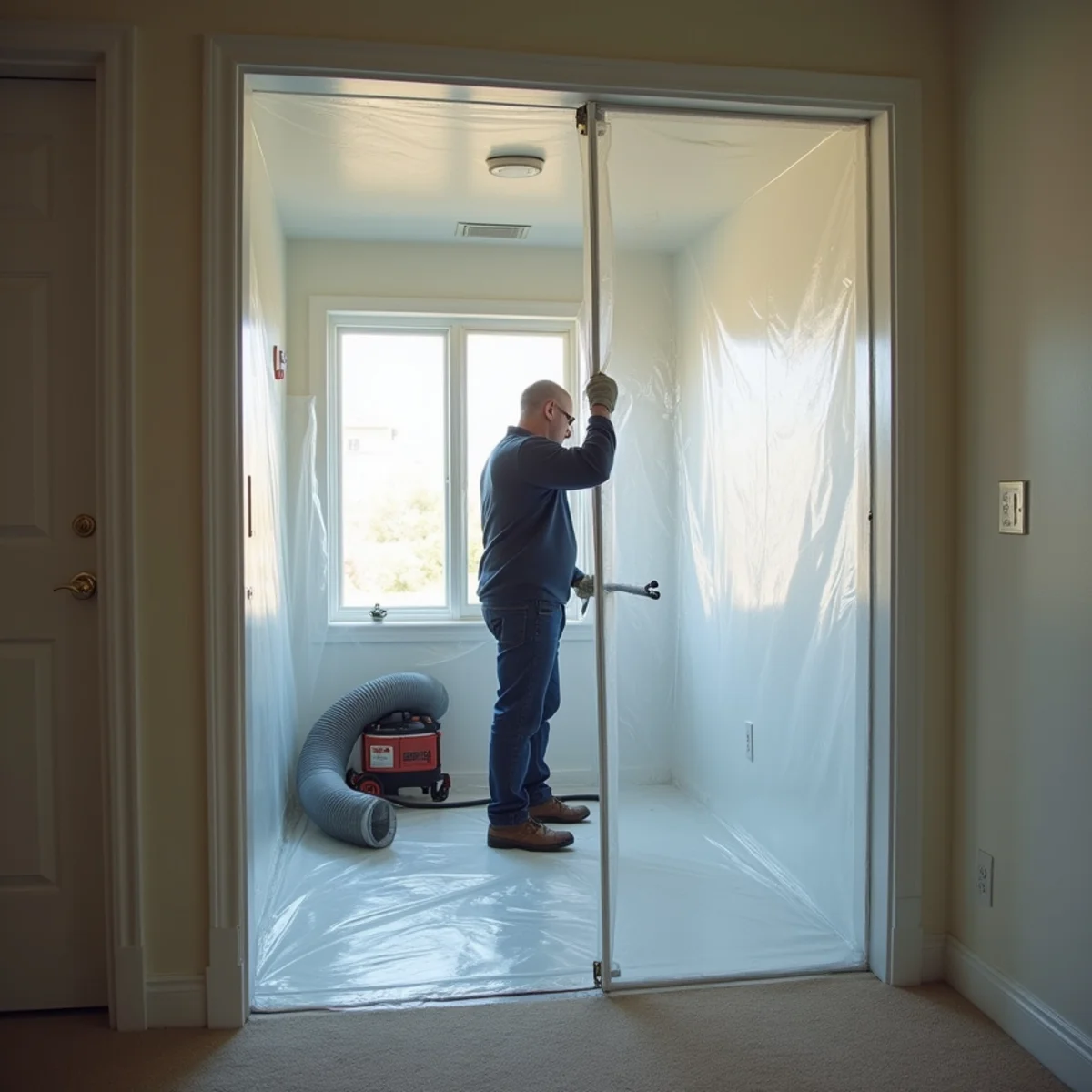
Proper remediation requires sealing the work area with physical barriers and putting it under negative air pressure with HEPA filtration, so that disturbing growth doesn't distribute spores through the rest of the house.
That costs more in:
- Occupied homes, where the barrier has to accommodate people living around it
- Multi-room spread, needing multiple chambers
- HVAC involvement, where the system has to be isolated or the ductwork addressed
- Commercial spaces that must stay partially operational
Containment is also the step cheap operators skip. If a quote seems remarkably low, ask specifically what containment and negative air are included — because remediation without them is how a bathroom problem becomes a whole-house problem.
4. The moisture repair underneath
Here's the cost nobody quotes you upfront: mold is a symptom, and the cause is a separate job.
If the growth is fed by a slab leak, someone has to fix the plumbing. If it's a roof leak, someone has to fix the roof. If it's a drainage problem, that's landscaping and grading work. If it's condensation from an HVAC issue, that's an HVAC contractor.
Remediation without fixing the cause is money spent on a delay. Any company that quotes you a remediation without identifying the moisture source is either not looking or not telling you.
5. Testing and clearance
Pre-testing to establish extent, and post-remediation clearance testing to verify the work, both add cost.
Our position: if you can already see growth, you generally don't need a test to know to remove it. Testing earns its keep when you can smell mold but can't find it, when you need documented extent for a claim or a real estate transaction, or when you want independent verification afterward.
For clearance, use an independent third-party hygienist rather than the remediation company. A firm grading its own homework has an obvious conflict of interest, and an independent result carries more weight with insurers and buyers. We'd rather refer you than test our own work.
Worth knowing: if a company offers a free mold test and then quotes a large remediation off the back of it, get a second opinion.
6. Rebuild scope
Remediation removes material. Something has to go back. Drywall, texture, paint, insulation, flooring, cabinetry — the same reconstruction costs as any other restoration job, and on a large remediation it can exceed the remediation itself.
What insurance typically does
Mold is one of the more restricted coverages in a California homeowners policy.
Often covered: mold resulting from a covered, sudden water event that you reported promptly — a burst pipe, an appliance failure.
Usually subject to a sub-limit. Many policies cap mold coverage at a specific dollar figure regardless of the overall policy limit. Check your declarations page for it now.
Usually excluded: mold from long-term leaks, humidity, condensation or maintenance failures.
The pattern that determines coverage is almost always how quickly the original water event was reported and dried. Which is the practical argument for calling on day one of a leak rather than day ten.
Why Inland Empire homes grow mold despite the dry climate
This surprises people. Rancho Cucamonga averages under 18 inches of rain a year with low ambient humidity — so how?
Because mold responds to the moisture content of the material it's on, not the regional average. The sources we find most:
- Slab leaks wetting carpet pad and wall bases from below, in the dark, for months
- Water heaters weeping into the drywall behind them in hot garages
- Under-sink leaks into particle board cabinet bases
- AC condensate from plugged lines or wet air handler platforms, all summer
- Roof and flashing failures after wind season, tracking down inside walls
And a hot, closed-up house in August is close to ideal growing conditions once something is wet.
How to keep the cost down
Call fast on the water event. Everything else is downstream of this. Mold begins in wet materials within 24–48 hours; dry inside that window and there's frequently nothing to remediate.
Don't disturb visible growth. Scrubbing or bleaching it distributes spores and expands the containment area you'll need.
Fix the moisture source properly, not provisionally.
Get an itemised scope, and ask specifically what containment is included.
The delayed-discovery pattern is what makes remediation expensive, and it's most common in rental-heavy areas like Rialto and in older housing stock like Claremont's pre-1960 homes, where a slow leak inside a plaster wall can run for months before anyone notices.
Free inspection and written scope: +1 (201) 277-9344.
FAQ
Questions people also ask
Why is crawl space mold so much more expensive?
Access. An 18-inch sub-area with one hatch means everything is done lying down, materials come out a bag at a time, and if the soil is contaminated the scope extends to vapor barrier replacement. The same nominal square footage can cost three times what an exposed wall would.
Should the remediation company do the clearance testing?
No — use an independent third-party hygienist. A company that both remediates and grades its own work has an obvious conflict of interest, and an independent clearance result carries far more weight with insurers and buyers. We'd rather refer you than test our own work.
Does insurance cover mold remediation?
Often, when it results from a covered sudden water event that was reported promptly — and usually subject to a specific mold sub-limit that applies regardless of your overall policy limit. Mold from long-term leaks, humidity or maintenance failures is typically excluded. Check your declarations page for the mold cap.
Can I get an estimate without an inspection?
Not a meaningful one. The cost is driven by how much affected material there is, where it is, and what containment the location demands — none of which can be established over the phone. Anyone quoting mold remediation sight unseen is either guessing or planning to revise it. The assessment itself is free, and it is what turns a range into a number.
Services mentioned
- Mold RemediationContainment, HEPA filtration, source removal and moisture correction — remediation that fixes the cause, not just the stain.
- Structural DryingAir movers and commercial dehumidifiers placed to a calculated load, with daily moisture readings you get to see.
- Leak DetectionThermal imaging, acoustic listening and moisture meters find the leak before we open anything up.
Keep reading

Cost & Insurance
Flood Insurance vs. Homeowners Insurance: Why Storm Flooding Usually Isn't Covered
The exclusion that surprises people every winter — and how to tell whether your property actually needs a separate flood policy.
5 min read

Cost & Insurance
Sewage Backup Cleanup Costs — and Whether Your Insurance Will Actually Pay
The endorsement most people don't have, the material that has to come out regardless, and where the money actually goes.
5 min read
Cost & Insurance
How to Document Water Damage for an Insurance Claim (Photo & Receipt Checklist)
Claims are paid from evidence, not recollection. Here's exactly what to capture, in what order, before anything gets cleaned up.
5 min read